Harvey and Marty and the Red ’57 Bel Air: A Virtual Run Down Route 66
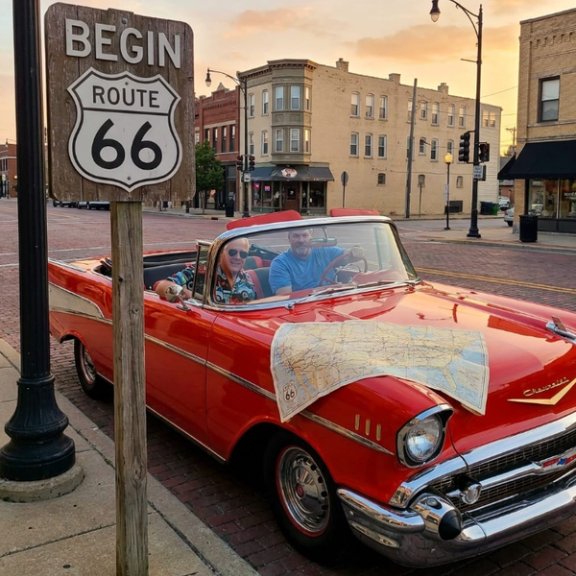
Harvey and Marty didn’t just “take a trip” on Route 66—they climbed into a shared daydream and let it carry them, mile by mile, from Chicago to the edge of the Pacific. In my mind, it always starts with the same small thrill: the moment Harvey and Marty picture the top down on a red 1957 Chevrolet Bel Air Convertible and feel, even before the engine turns over, that old promise of the open road tugging them forward.
This memory is brought to you by Red Bike Coffee Company — Second test partner
This story is brought to you by Red Bike Coffee Company
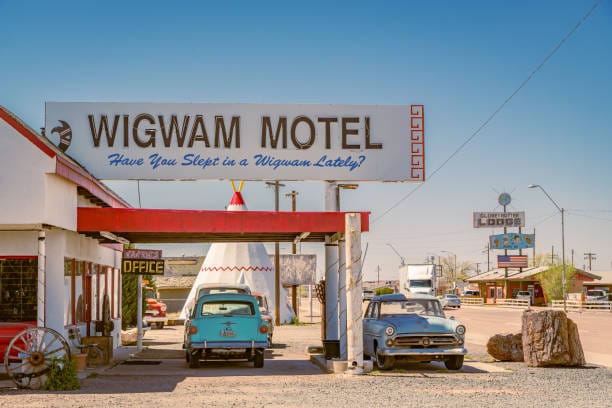
"Harvey and Marty Take A Virtual Road Trip On Route 66, in Harvey’s Classic Dream Car a 1957 Chevrolet Bel Air Convertible, known as The Mother Road, spans roughly 2,448 miles (3,940 km) through eight states, beginning in Chicago, Illinois, and ending at the Santa Monica Pier, California. While the road was officially decommissioned in 1985, about 85% of it remains drivable today via historic alignments and state highways. Essential Planning Tips**** Duration: A minimum of 14 days is recommended to see the major highlights without rushing. A leisurely pace can take up to 3 weeks. Timing: Spring (May) and Fall (September to October) offer the best weather and fewer crowds. Summers are extremely hot in desert stretches, and winters can bring road closures in the north. Navigation: Traditional GPS often defaults to interstates. Use specialized resources like the Route 66 Navigation App or the EZ66 Guide for Travelers to stay on the historic path. Centennial Celebration: The year 2026 marks the Route 66 Centennial, featuring special events and tours across all eight states. Top Must-See Stops by State**** Illinois: The \"Begin Route 66\" sign in Chicago and the Cozy Dog Drive In (birthplace of the corn dog) in Springfield. Missouri: The Gateway Arch in St. Louis and the Meramec Caverns, which feature vintage barn advertisements. Kansas: ***The shortest stretch (13 miles), featuring Cars on the Route in Galena. Oklahoma: The Blue Whale of Catoosa and the futuristic Pops 66 soda ranch in Arcadia. Texas: The Cadillac Ranch in Amarillo and the Midpoint Café in Adrian, the mathematical center of the route. New Mexico: The historic Blue Swallow Motel in Tucumcari and the Spanish-influenced plaza in Santa Fe. Arizona: The Wigwam Motel in Holbrook, Standin' on the Corner Park in Winslow, and the gateway to the Grand Canyon in Williams. California: The desolate Roy's Motel & Café in Amboy and the iconic End of the Trail sign at the Santa Monica Pier. ========================================== 1957 Chevrolet Bel Air Convertible The 1957 Chevrolet Bel Air Convertible is one of the most celebrated and highly sought-after icons of American automotive history. Serving as the absolute peak of General Motors’ famous \"Tri-Five\" generation (1955–1957), this drop-top model beautifully captured the optimistic, \"Jet Age\" styling of late-1950s pop culture Key Styling & Design Features Dramatic Tail Fins: Sharp, sweeping fins capped with chrome moldings that defined the vehicle's side profile. Gold Anodized Accents: Upscale premium styling exclusive to the Bel Air tier, featuring a gold mesh grille insert, gold trunk script, and front fender chevrons. Lower Stance: Shrunk down from 15-inch wheels to 14-inch wheels to provide a longer, lower, and sleeker ride. Twin Hood Rockets: Windshield cowl vents were eliminated and cleverly reimagined as dual rocket-style twin scoops on the hood. Hidden Fuel Door: The gas cap was cleverly concealed behind the driver-side rear chrome trim piece. Engine & Mechanical Lineup The '57 Bel Air was a technological standout because it introduced highly sophisticated powertrain configurations for its era: The 283 V8: Chevrolet's small-block V8 grew to 283 cubic inches for 1957, available in multiple configurations including the popular four-barrel \"Power Pack\". Ramjet Fuel Injection: A rare option featuring continuous fuel injection. Finding an original \"Fuelie\" convertible is incredibly tough, as only a minuscule number of buyers paid for the pricey upgrade. Dual-Quad Carburetors: High-performance variants offered dual Carter carburetors paired with a batwing air cleaner, pushing up to 270 horsepower. Chassis Rigidity: Convertibles featured a specialized, robust X-shaped crossmember in the center of the frame to offset the structural loss of a fixed roof. Rarity & Current Market Value Chevrolet manufactured roughly 47,000 to 48,000 Bel Air convertibles for the 1957 model year. Because of their cultural prestige, they command premium numbers in the collector market ========================================== #1957chevroletbelairconvertible #chevroletbelairconvertible #OfficialPaceCar #BodyByFisher #Chevrolet #CarGurus #CLASSIC #Route66 #WinslowArizona #ChicagoIllinoi #SantaMonicaPierCalifornia #Route66Centennial #CozyDogDriveIn #MeramecCaverns #CarsontheRoute #WhaleofCatoosa #Pops66 #StandinontheCorner #MidpointCafé #WinslowVisitorsCenter #BlueSwallowMotel #MinnetonkaTradingPost #WigwamMotel #GrandCanyon #EndoftheTrail"
The way Harvey and Marty hold the map (even when it’s virtual)
What I love about the way Harvey and Marty tell it is that the details don’t feel like trivia—they feel like care. In their version, Route 66 isn’t a red line across a screen; it’s eight states’ worth of “don’t miss this,” the kind of gentle arguing you do with someone you trust: Do we stop for the Cozy Dog in Springfield? Do we pull over for the barn ads near Meramec Caverns? Do we take the shortest little Kansas stretch just so we can say we did?
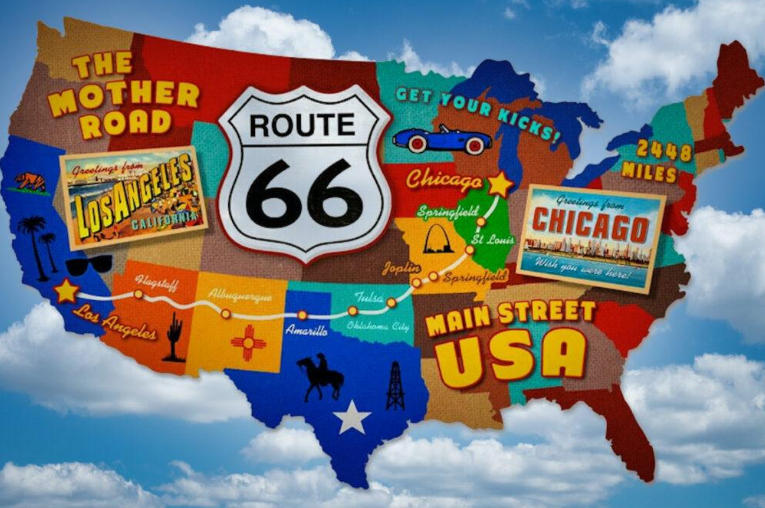
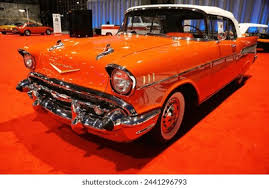
And because it’s Harvey and Marty, the car is never background. That red 1957 Chevrolet Bel Air Convertible is the lens the whole trip is seen through—the chrome catching the light, the fins slicing the air like they still believe the future is going to be kinder than the past. You can almost feel the way the Bel Air sits lower on its 14-inch wheels, as if it was built to glide—built to make every little town along the route feel like it’s part of the same long, welcoming sentence.
Stops that turn into stories
Illinois is where Harvey and Marty “begin,” and I imagine them pausing at that “Begin Route 66” sign in Chicago the way you pause at the front door before a big night out—half excitement, half reverence. From there it’s Springfield for the Cozy Dog Drive In, and it’s easy to picture them laughing at the perfect weirdness of it: a place famous for something you can eat in a car without even pretending to be civilized.
Missouri has that shift you always feel when a road trip becomes real: the Gateway Arch in St. Louis like a clean metallic exhale, then Meramec Caverns with its old barn advertisements—signs that were painted to be seen fast, to be remembered later. Harvey and Marty’s trip carries those kinds of echoes. Even virtually, you can sense the older America standing just off the shoulder, waving.
Kansas is almost comically short—13 miles—and that’s exactly why it works. Harvey and Marty don’t rush past it; they honor it. They stop at Cars on the Route in Galena, because sometimes you only need a moment, a photo, a grin—proof you were there together, even if “there” was brief.
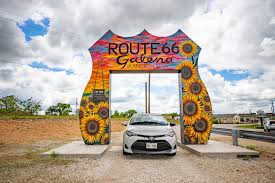
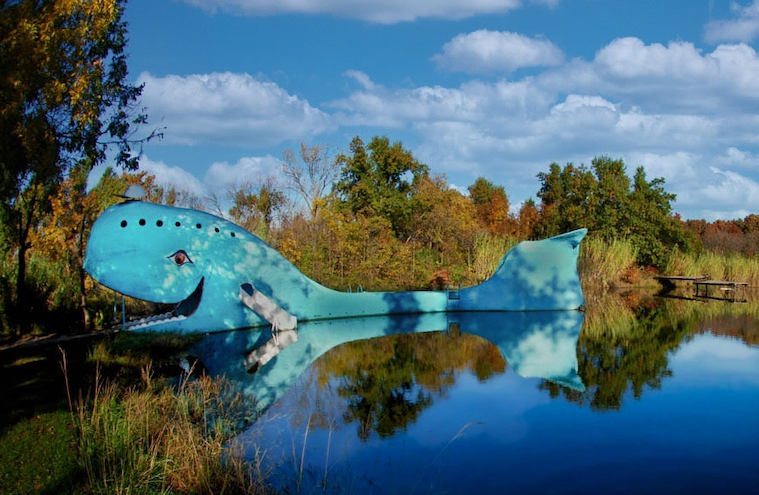
Oklahoma is where their trip starts to feel playful. The Blue Whale of Catoosa is the kind of roadside joy that makes you forget the clock, and Pops 66 in Arcadia has that glowing, futuristic wink—like the Jet Age never ended, it just learned to sell soda. It’s easy to imagine Harvey and Marty in that Bel Air, looking at a wall of bottles and feeling young again in the way only a road can manage.
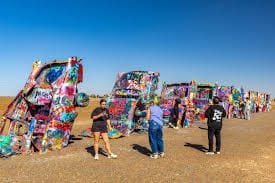
Texas gives them the kind of iconic weirdness you can’t invent: Cadillac Ranch in Amarillo, then Midpoint Café in Adrian—the mathematical center of the whole thing. There’s something fitting about Harvey and Marty pausing at the midpoint, because a midpoint isn’t just a distance marker. It’s a quiet check-in. It’s the place where you realize you’re committed now—you’re going to see this through, all the way to the water.
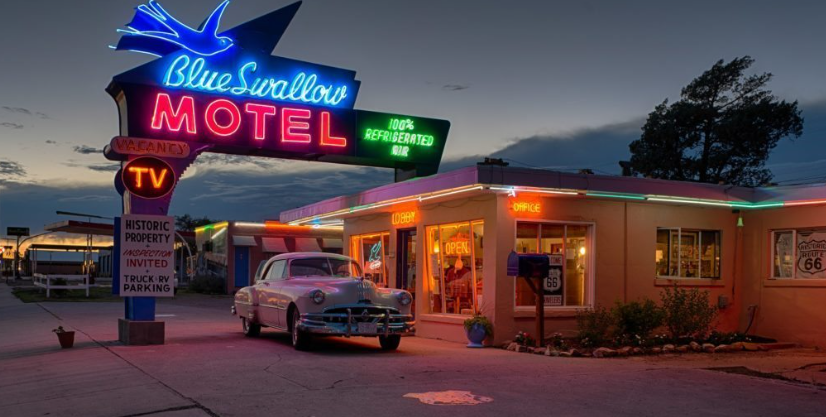
In New Mexico, the Blue Swallow Motel in Tucumcari feels like a soft landing. I can see Harvey and Marty noticing the glow of its vintage sign, that specific kind of neon that doesn’t just light up the night—it makes the night feel friendly. And Santa Fe’s plaza brings in a different texture: Spanish-influenced corners, slower footsteps, the sense that the road is teaching you new rhythms as you go.
Arizona is where the memory picks up its own soundtrack. The Wigwam Motel in Holbrook looks like the kind of place you’d swear you saw on a postcard once. Standin’ on the Corner Park in Winslow is practically a lyric turned into a location, and I picture Harvey and Marty smiling at that—at how America can be so sincere about its own pop culture. And then Williams, the gateway to the Grand Canyon, where the sky starts to feel bigger than the plan.
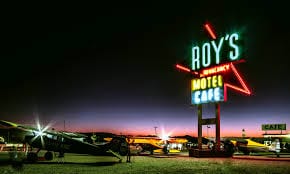
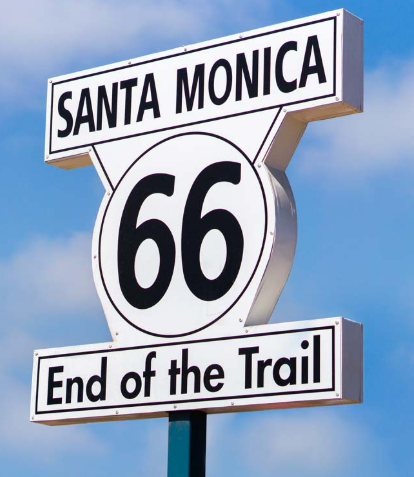
California is the last long stretch of holding your breath. Roy’s Motel & Café in Amboy sits there like a relic that refuses to apologize for its loneliness, and that’s part of why it hits. Harvey and Marty’s Bel Air—red against the desert—feels like a moving dot of warmth. Then Santa Monica Pier: the End of the Trail sign, the ocean air, the sense that a line you’ve carried in your head for so long finally gets to end in something you can hear.
The car that makes it all feel possible
Harvey and Marty’s affection for the 1957 Bel Air isn’t just about having a “classic.” It’s about how specific the dream is. The twin hood rockets. The hidden fuel door that feels like a secret handshake. The gold accents that aren’t subtle and never tried to be. Even if all you do is picture it, you understand why it had to be this car: the Bel Air doesn’t whisper; it declares.
And there’s something quietly tender about the fact that Route 66 was officially decommissioned in 1985, yet so much of it still lives—still drivable, still findable if you care enough to stay off the interstates. That’s the same kind of endurance a good shared memory has. Harvey and Marty’s road trip works because it isn’t trying to outrun time. It’s doing the opposite: it’s revisiting, restoring, polishing the chrome of a story until it reflects them back to themselves.
Looking ahead, without letting go
When Harvey and Marty mention the Route 66 Centennial in 2026, it doesn’t land like an event listing. It lands like an invitation—one more reason to keep the dream close, to keep imagining that red convertible rolling past neon and diner windows, two men carrying the same private grin. Because the truth is, their version of Route 66 isn’t trapped in one year. It’s a place they can return to whenever they want: hands on an invisible steering wheel, hearts tuned to the same station.
Photos from the Memory


About the Storyteller
Harvey and Marty
Memory from 1957
Connect with Harvey using the info below:
https://www.facebook.com/silver.fox.9862/