
Edward Collins and the Day London Exhaled: Whitehall on VE Day, 1945
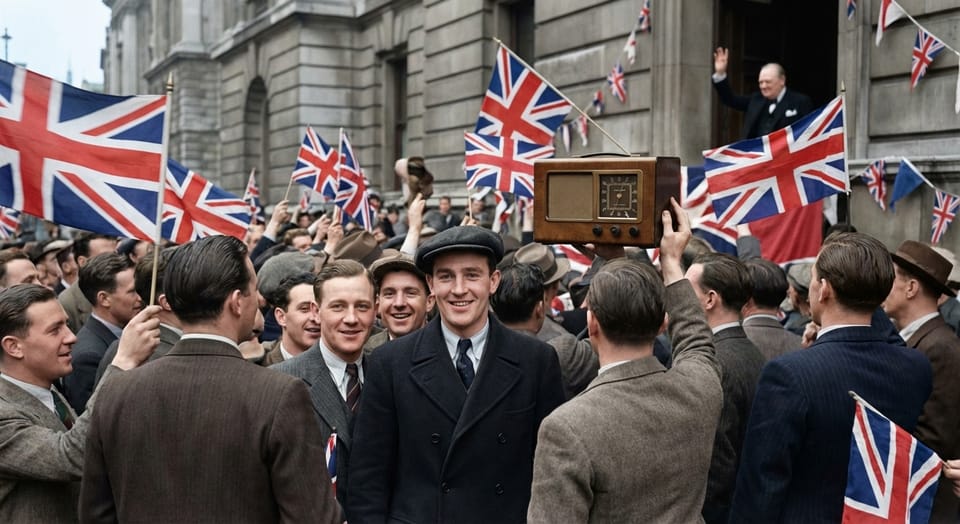
Edward Collins still remembers London as if it had a pulse you could hear—beating in footsteps, in singing, in the sudden honesty of people who didn’t have to pretend to be brave for one more night.
This memory is brought to you by Oh Sherri Irish Pub — Testing the partner system

This story is brought to you by
Oh Sherri Irish Pub
Testing the partner system
Visit Oh Sherri Irish Pub →The streets of London were alive in a way I had never seen before. After years of blackout curtains, rationing, and constant uncertainty, the news had finally come—victory in Europe. People poured out into the streets, waving flags, embracing strangers, singing songs that had carried them through the darkest days. I found myself swept along toward Whitehall, where the crowd grew thicker with every step. When Winston Churchill appeared, there was a roar that seemed to shake the air itself. He stood firm, raising his hand in that now-famous gesture, and for a moment, everything felt still despite the noise. We had heard his voice so many times on the radio during the war—steady, determined, refusing to give in. Seeing him there in person felt different. Real. That day wasn’t just about victory. It was about endurance. And standing there in that crowd, I realized we had all carried a piece of that weight together.
Where the sound came from
What stays with Edward Collins isn’t only the sight of Union Jack flags—bright against a city that had spent so long dimmed and disciplined—but the way sound moved through London that day, like weather. It wasn’t one cheer. It was a surge: voices rolling down streets, laughter breaking into song, and the kind of shouting that doesn’t threaten anyone because it’s made of relief.
And threaded through it all was the radio—the wartime companion that had lived in kitchens and sitting rooms, that had made announcements feel both close and impossibly far away. In 1945, a radio wasn’t background noise. It was a lifeline with a speaker grille. Edward Collins had already trusted that steady, determined voice in the dark years; on this day, the city answered it out loud.
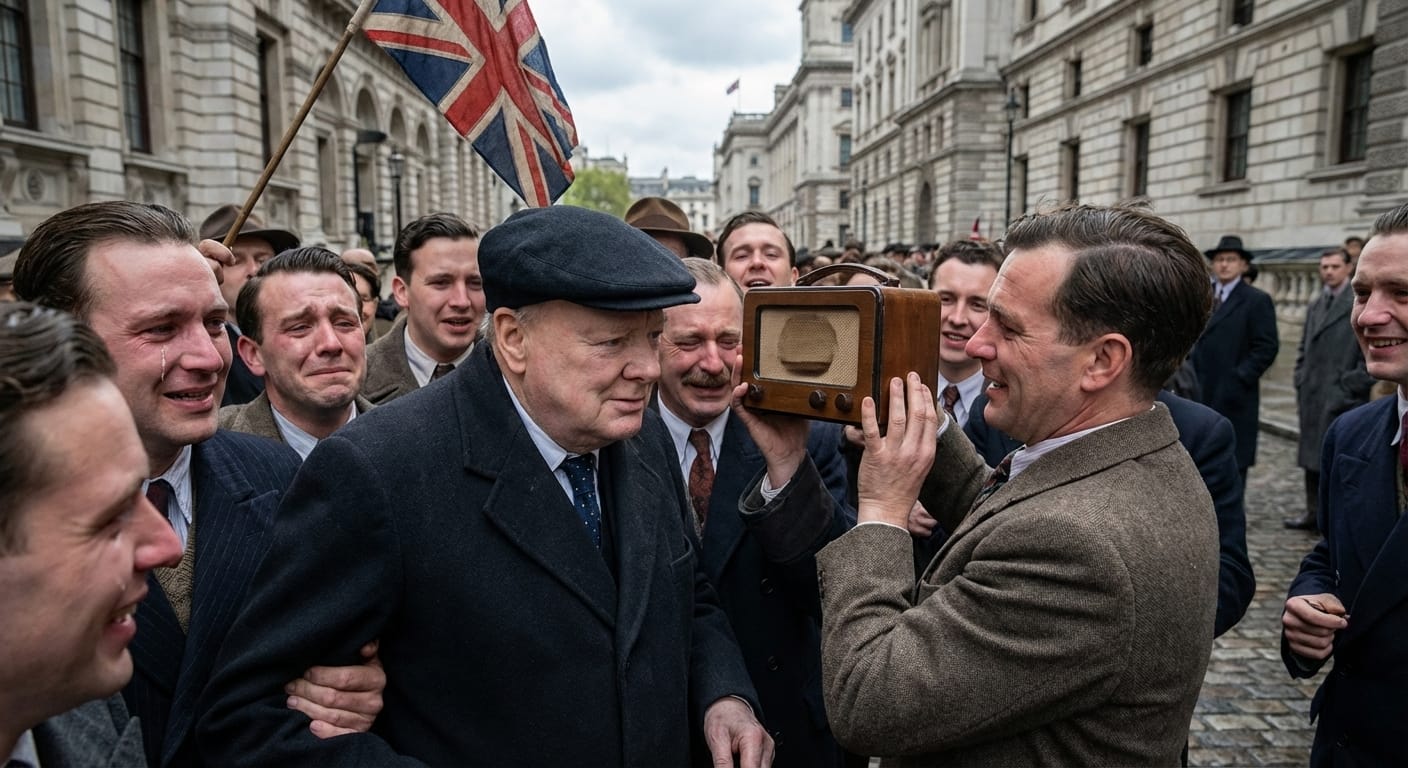
Whitehall, shoulder to shoulder
Edward Collins describes being “swept along,” and that word tells the truth of it: this wasn’t a careful walk, a planned outing, or a polite queue. It was the rare day when London forgot to keep its manners buttoned up. The crowd thickened with every step toward Whitehall, and with it came the strange intimacy of strangers—arms brushing, breath close, faces turned the same direction as if the whole city had become one body leaning forward.
There’s something unforgettable about realizing you’re part of a moment without being able to hold onto any single detail. You can’t choose what to notice: a flag flapping close enough to sting your cheek, a snatch of a familiar song, the warmth of someone laughing behind you. Edward Collins doesn’t paint it as tidy. He remembers it as alive.
Seeing Churchill made it real
When Winston Churchill appeared, Edward Collins felt the roar “shake the air itself.” It’s a physical memory, not a historical footnote—sound you could feel in your ribs. Churchill’s raised hand, the now-famous gesture, isn’t described like an icon in a textbook. It lands as a human confirmation: the voice from the wireless had stepped into the same daylight as everyone else.
Edward Collins had heard Churchill during the war the way most people did—through radio broadcasts that carried steadiness into homes that were trying not to be frightened. Seeing him in person rearranged something inside Edward Collins: the war years stopped being only something endured privately behind blackout curtains and became, unmistakably, something endured together.
Not just celebration—release
Edward Collins doesn’t frame the day as simple happiness, and that’s what makes it ring true. Victory wasn’t only fireworks and singing; it was the sudden removal of a weight you’d grown used to holding. When you’ve lived with rationing and constant uncertainty, relief can feel almost disorienting—like stepping off a ship and still feeling the sea in your legs.
What Edward Collins carries forward from 1945 is the realization that endurance had been shared, even when it felt solitary. In that crowd, he understood the quiet mathematics of wartime life: every family adding its own small burden, every street absorbing its own losses, until the city as a whole could finally exhale.
Photos from the Memory

About the Storyteller
Edward Collins
Memory from 1945