Lenny and the April 15, 1955 Headline That Opened the Golden Arches
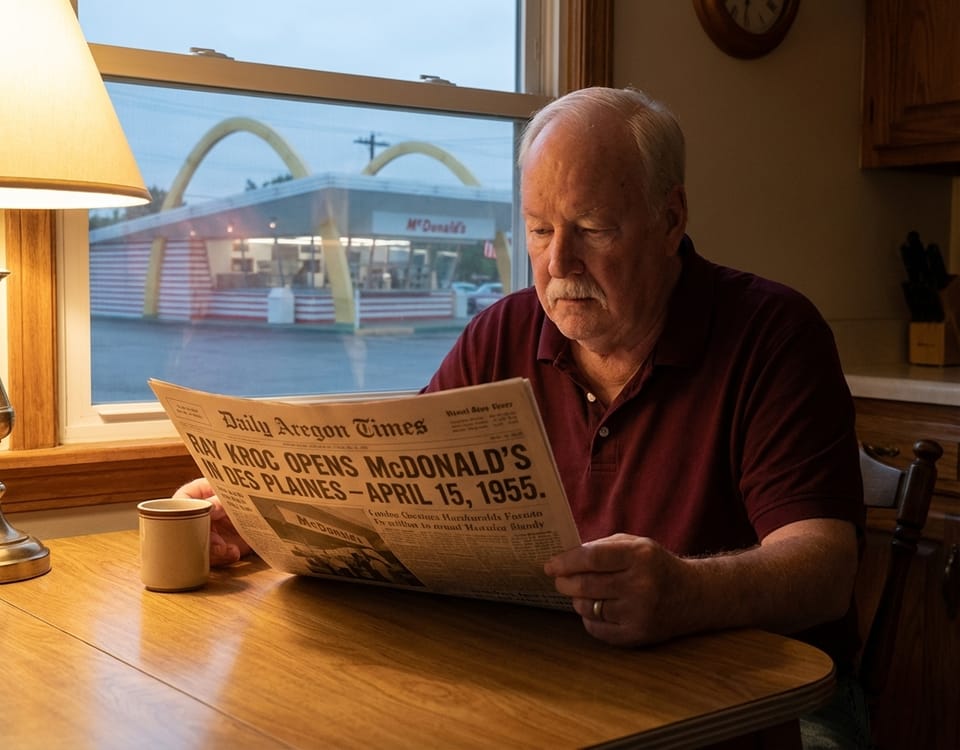
Lenny has a way of holding history like it’s something you can fold up and keep in your pocket—like a newspaper you don’t throw away because the ink feels warm, because the date matters, because the ordinary world changed a little on that page.
This memory is brought to you by Red Bike Coffee Company — Second test partner
This story is brought to you by Red Bike Coffee Company
This Date In History On April 15, 1955, Ray Kroc opened his first franchised McDonald's restaurant in Des Plaines, Illinois. Lenny Goes Back To April 15, 1955 and Finds a Paper Headlines Saying: “Ray Kroc opened his first franchised McDonald's restaurant in Des Plaines" On April 15, 1955, Ray Kroc opened his first franchised McDonald's restaurant in Des Plaines, Illinois. While the McDonald brothers had opened the original location in San Bernardino, California, in 1940, the opening of this Illinois location marked the official founding of the McDonald's Corporation McDonald’s Corporation . Key Facts About the Des Plaines Opening First-Day Performance: The restaurant recorded first-day sales of $366.12. The Menu: Customers could purchase a hamburger for 15 cents or French fries for 10 cents. Design Iconography: The building featured a distinctive red-and-white tiled exterior and the first use of the Golden Arches designed by architect Stanley Meston. Original Mascot: Long before Ronald McDonald, the mascot was #Speedee, a chef hat on top of a #hamburger. The Site Today Demolition and Replica: The original 1955 structure was demolished in 1984. A faithful replica, known as the McDonald’s #1 Store Museum, was built on the site in 1985 to preserve its history. Final Removal: Due to repeated flooding from the nearby Des Plaines River, the museum closed to the public in 2008 and was ultimately demolished in 2018. Land Donation: Following the demolition, McDonald's donated the land at 400 Lee Street to the City of Des Plaines.
Where Lenny’s Mind Lands: Des Plaines, Ink, and a Brand-New Promise
When Lenny “goes back” to April 15, 1955, it doesn’t feel like trivia—it feels like standing near the counter and letting the moment come into focus. A paper headline. A town name you can say out loud—Des Plaines, Illinois—and suddenly it’s not just a place on a map; it’s a coordinate in Lenny’s private atlas of American turning points.
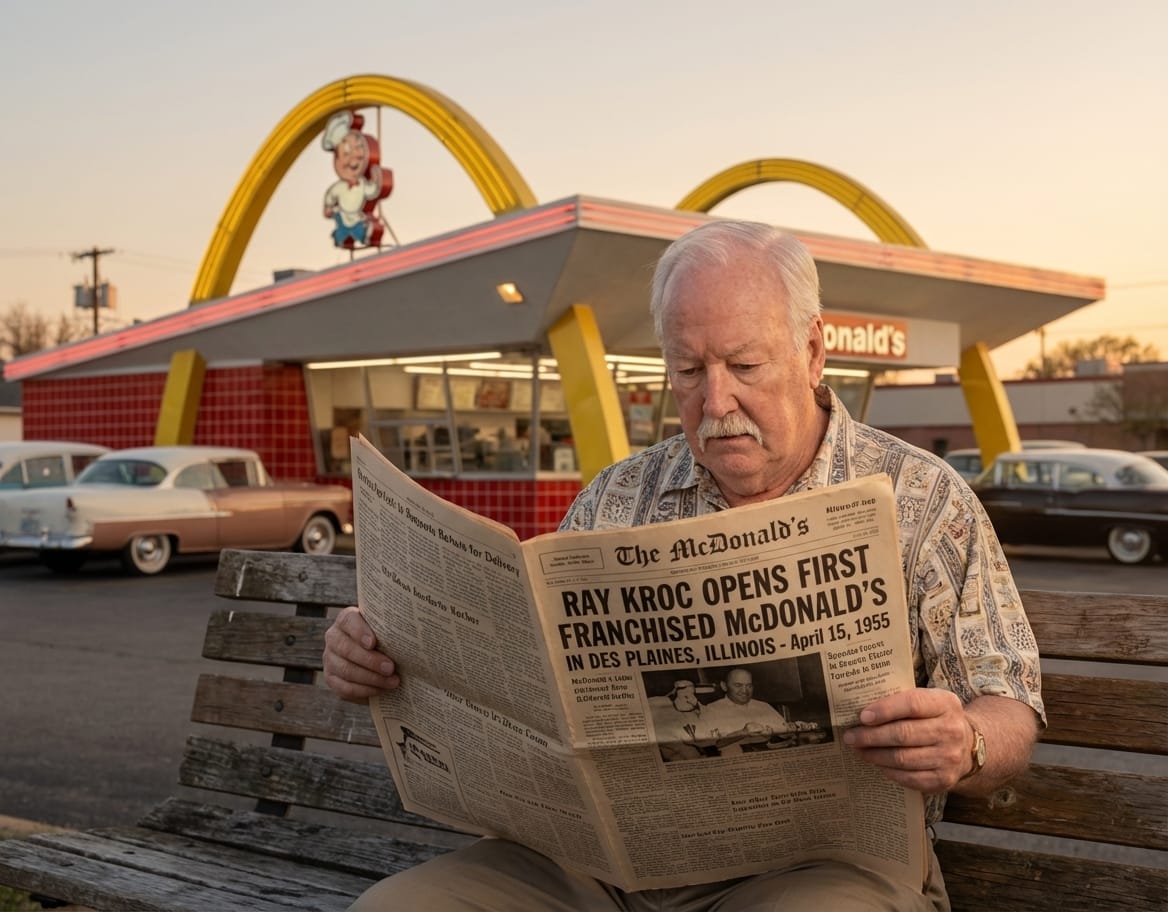
What sticks with Lenny is how specific it all was: the first-day sales—$366.12—so exact it reads like it was typed with pride. Not millions. Not empires. Just a single day where people showed up, ordered food, and proved an idea could work outside of California.
And the prices—15 cents for a hamburger, 10 cents for fries—carry their own kind of ache. Lenny isn’t just reading numbers; he’s hearing the clink of coins, picturing palms opening, imagining how small those amounts must’ve felt and how big the taste of “fast” must’ve seemed in 1955.
The Little Details Lenny Refuses to Let Disappear
Lenny notices what most people skip: the building itself, the red-and-white tile like a clean promise, and those first Golden Arches—new then, not yet a global shorthand. In Lenny’s memory, the arches aren’t corporate; they’re architectural, a bold shape someone chose on purpose because they wanted drivers to see it and feel curious.
And then there’s Speedee—the original mascot—before the world turned the brand into something else. Lenny holding onto Speedee feels like Lenny protecting the early, almost innocent version of the story: when it was still a chef-hat-on-a-hamburger and not an entire universe of branding.
What Makes It Tender: Even the “Museum” Didn’t Last
There’s something quietly heartbreaking in the way Lenny tells the back end of the timeline. The original 1955 structure was demolished in 1984. A replica rose in 1985 to preserve what was already slipping away. Then the flooding from the Des Plaines River kept insisting on its own truth, until the museum closed in 2008 and was finally demolished in 2018.
For Lenny, that’s the part that turns the headline into something personal: even when we try to rebuild the past carefully—brick by brick, tile by tile—the world keeps moving. Water rises. Doors close. Land gets donated. The physical place disappears, and what’s left is the thing Lenny started with in the first place: a date, a headline, a story you can still carry.
Photos from the Memory


About the Storyteller
Lenny
Memory from 1955
Connect with Lenny using the info below:
https://www.facebook.com/silver.fox.9862/