
Ken and the Headline That Still Hits: “TITANIC SINKS, 1500 DIE” (April 15, 1912)
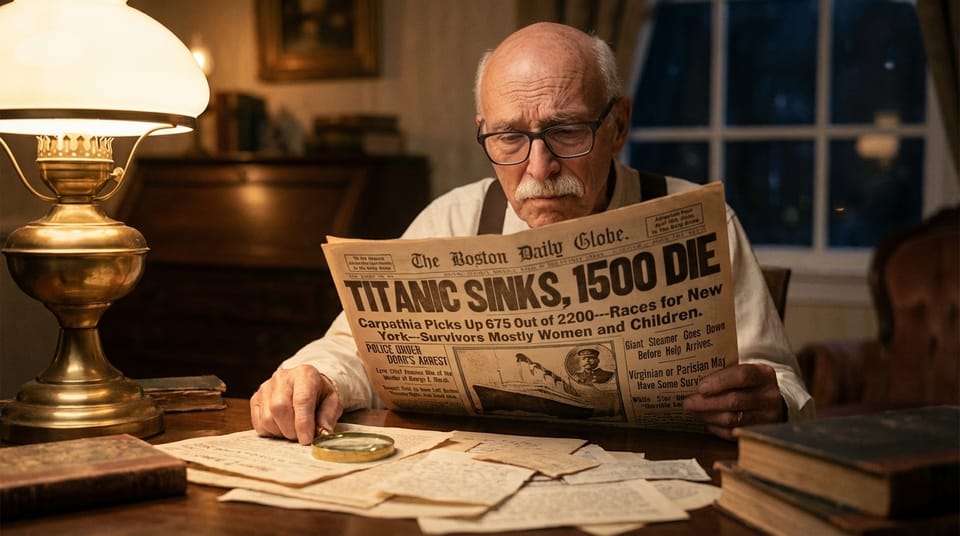
Ken has a way of going straight to the source—past the polished retellings and straight into the ink-and-paper shock of how history first arrived on people’s doorsteps. When Ken researches April 15, 1912, it isn’t the movie score or the museum display that lands hardest. It’s the blunt newspaper language, the kind that doesn’t cushion grief—just delivers it.
This memory is brought to you by Oh Sherri Irish Pub — Testing the partner system

This story is brought to you by
Oh Sherri Irish Pub
Testing the partner system
Visit Oh Sherri Irish Pub →""This Date In History April 15, 1912 "The Sinking of the RMS Titanic!" Ken Researches and Finds Paper Headlines Saying: “TITANIC SINKS, 1500 DIE” (Aril 15, 1912) The RMS Titanic sank in the early hours of April 15, 1912, after striking an iceberg in the North Atlantic during its maiden voyage from Southampton to New York City. Of the estimated 2,224 passengers and crew on board, more than 1,500 people perished, making it one of history's deadliest peacetime maritime disasters. Timeline of the Sinking The disaster unfolded over approximately two hours and 40 minutes: 11:40 p.m. (April 14): Lookouts Frederick Fleet and Reginald Lee spotted an iceberg directly ahead. Despite a "hard-a-starboard" turn and reversing engines, the ship's starboard side scraped the iceberg. 12:00 a.m. (April 15): Captain Edward J. Smith was informed that five forward watertight compartments were flooding. The ship was only designed to stay afloat with four compartments breached. 12:05 a.m.: Lifeboats were ordered uncovered and passengers mustered. Distress signals (CQD and SOS) were sent out. 12:45 a.m.: The first lifeboat (No. 7) was launched, significantly under-capacity with only 28 people despite a capacity of 65. 2:17 a.m.: The ship's lights failed. The hull, under immense strain as the stern rose out of the water, broke in two. 2:20 a.m.: The stern disappeared beneath the surface, and the Titanic foundered. Key Factors in the Tragedy Insufficient Lifeboats: The ship carried only 20 lifeboats, enough for 1,178 people—barely half of those on board. While inadequate, this actually exceeded the legal requirements of the time. Evacuation Lapses: A "women and children first" protocol was followed, but confusion led to many boats being launched half-full. Third-class passengers faced significant difficulties reaching the boat deck due to the ship's complex layout. Nearby Ships: The SS Californian was less than 20 miles away but failed to respond because its radio operator was off-duty. The RMS Carpathia arrived roughly 90 minutes after the sinking to rescue 710 survivors. The Wreckage Today The wreck was discovered on September 1, 1985, by a joint American-French expedition led by Robert Ballard and Jean-Louis Michel. It lies in two main pieces approximately 12,500 feet (3,800 meters) deep, about 350 nautical miles off the coast of Newfoundland. The site is currently being consumed by metal-eating bacteria (Halomonas titanicae), and some scientists predict the structure may collapse entirely within the next few decades.""
Where Ken’s Research Turns Into Something You Can Feel
That headline—“TITANIC SINKS, 1500 DIE”—is what makes Ken’s “This Date In History” entry feel personal. It’s not a story that starts with romance or luxury; it starts with a gut-punch of type set for strangers who had no warning this was coming. Ken doesn’t just read the words. Ken hears the newsroom urgency in them, the way a whole world must have learned, in one hard sentence, that “unsinkable” was just a hopeful word people said before they knew better.
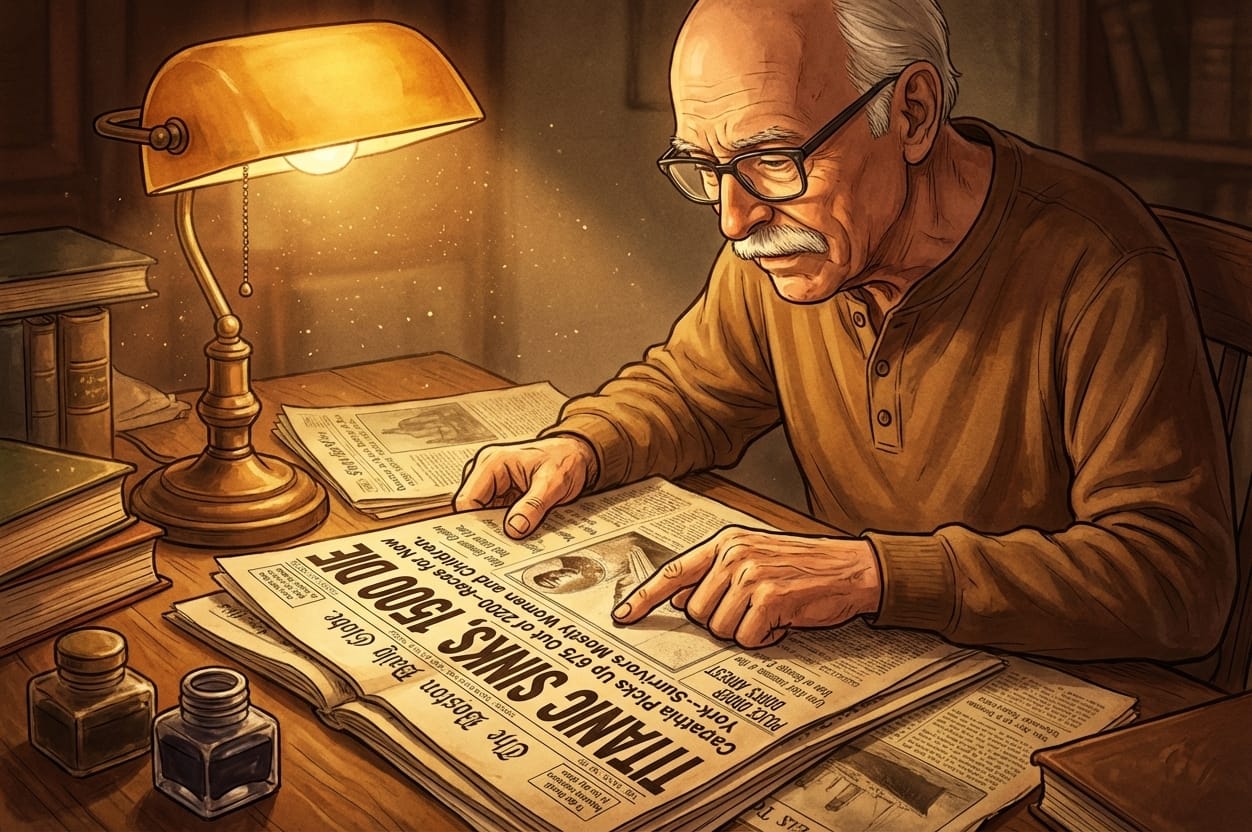
And once Ken lays out the timing—11:40 p.m. to 2:20 a.m.—the tragedy stops being an old legend and turns into a clock you can’t ignore. Two hours and forty minutes is long enough to make choices, long enough to believe a miracle might still happen, long enough to feel your certainty drain away in stages. When Ken lines those minutes up, it reads like someone steadily turning down a light.
The Details Ken Chose—And Why They Matter
Ken didn’t get lost in trivia. Ken focused on the moments where the story becomes human: the first lifeboat leaving under-capacity, the ship’s lights failing at 2:17 a.m., the nearby ship that didn’t answer because a radio operator was off-duty, and then the Carpathia arriving to rescue 710 survivors. These aren’t just “facts.” They’re the points where the disaster becomes a chain of decisions and absences—small gaps that widen into something unthinkable.
There’s something especially haunting in the way Ken notes the lifeboats: twenty boats, room for 1,178, and yet some launched half-full. That’s the kind of detail that stays with you because it doesn’t behave like history is supposed to behave. You want order and logic; what you find instead is confusion, hesitation, blocked passageways, and the cruel reality that rules and layouts can decide who gets a chance to live.
What Ken Is Really Holding in That Headline
Ken’s memory isn’t only about the Titanic. It’s about how Ken approaches the past: with respect, with patience, and with a need to see it the way people first saw it—unsoftened. A newspaper headline is a strange kind of artifact; it’s not an object from the ship, but it carries the moment when the world changed its mind about safety, certainty, and modern pride.
And when Ken includes the wreck “today”—lying in two pieces, 12,500 feet down, slowly being consumed by metal-eating bacteria—there’s a quiet kind of mercy in that detail. Not because it’s less sad, but because it reminds you the ocean keeps time differently than we do. Ken’s research holds the whole arc at once: the confident launch, the short violent timeline, the delayed rescue, and then the long, slow fading of steel into the deep.
Ken’s “This Date In History” entry reads like a personal ritual: naming the hour, naming what failed, naming what was lost—so it doesn’t get turned into background noise. And that’s the thing about the Titanic story in Ken’s hands: it’s not spectacle. It’s a date, a headline, and a pause long enough to feel what those words meant when they were brand-new.
Photos from the Memory


About the Storyteller
Ken
Memory from 1912
Connect with Ken using the info below:
https://www.facebook.com/silver.fox.9862/