
Chris and Jerri Gallatin and the Old Newspaper Headline That Led to the Feejee Mermaid
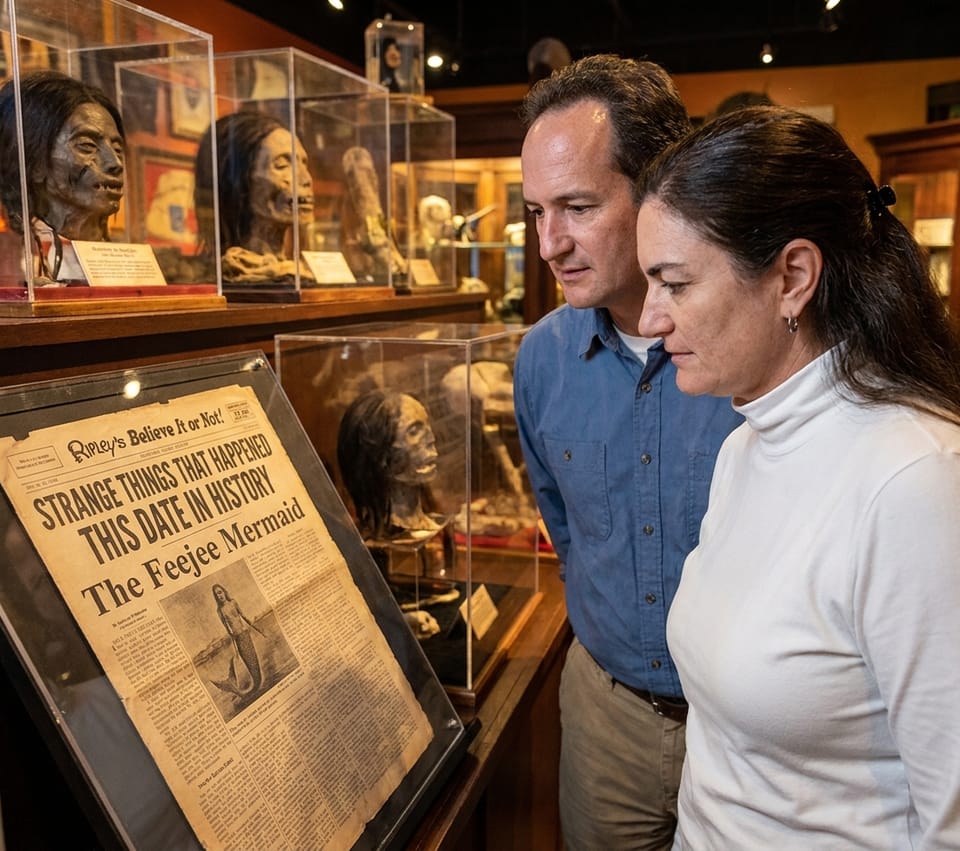
Chris and Jerri Gallatin weren’t hunting for a lesson in deception—they were just moving through another Ripley’s Believe It or Not! stop, letting the museum do what it always does: fill your eyes with oddities until your brain feels pleasantly untethered. And then, in the middle of all that curated weird, an old newspaper headline reached up and grabbed them by the shirtfront—the kind of moment where the day suddenly has a pin stuck in it, so you’ll remember exactly where you were standing.
This memory is brought to you by Red Bike Coffee Company — Second test partner
This story is brought to you by Red Bike Coffee Company
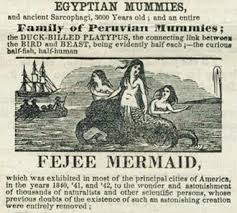
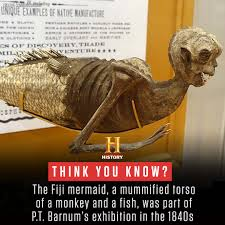
"Chris and Jerri Gallatin Find An Old Newspaper with Headlines Saying: Strange Things That Happened This Date In History "The Feejee Mermaid" Reading The Newspaper While Touring Various Ripley's Believe It or Not Museum. The Feejee Mermaid was one of the most famous sideshow hoaxes in history. It was popularized by legendary showman P.T. Barnum in 1842. Far from a beautiful, mythical siren, the object was actually a grotesque, mummified taxidermy creation. It was made by stitching together the head and torso of a young monkey and the tail half of a large fish.📜 Origins and History Japanese Craftsmanship: Around 1810, Japanese fishermen or Southeast Asian artisans crafted the object. Fusing monkey and fish parts was a traditional, albeit bizarre, art form in the region. The items were sometimes used in religious ceremonies or sold to tourists. The Transatlantic Journey: An American sea captain named Samuel Barrett Edes purchased the specimen from sailors in 1822 for $6,000. He spent a massive portion of his ship's expense account to secure it. Edes exhibited the mermaid in London, but it failed to bring him wealth, and he died broke. Acquisition by Barnum: Edes's son eventually sold the specimen to Moses Kimball, the owner of the Boston Museum. In 1842, Kimball leased the artifact to P.T. Barnum for his American Museum in New York City.🎪 Barnum's Marketing Genius Barnum knew that simply putting a ugly specimen on display wouldn't draw crowds. He orchestrated an elaborate publicity stunt: Fake News: Barnum sent anonymous, fabricated letters to New York newspapers. The letters claimed a Dr. J. Griffin of the "Lyceum of Natural History in London" had caught a real mermaid in the Fiji Islands. The "Expert" Witness: "Dr. Griffin" was actually an accomplice named Levi Lyman, hired by Barnum to pretend to be a credentialed British scientist validating the find. The Beautiful Lie: The marketing pamphlets and advertisements distributed by Barnum depicted a stunning, bare-breasted, beautiful woman with a fish tail.👁️ The Grotesque Reality When paying customers flooded into Barnum’s American Museum, they were shocked to find a horrific, dried-up creature. Barnum later described the Feejee Mermaid as an "ugly, dried-up, black-looking diminutive specimen... which gave it the appearance of having died in great agony". The object featured: The bared teeth and shriveled face of an agitated monkey Fused papier-mâché, clay, and animal hair to hide the stitching The lower body, scales, and tail fin of a salmon or carp🔍 Where is it Now? The location of Barnum's original Feejee Mermaid remains a mystery. It is widely believed to have been destroyed in one of the catastrophic fires that burned down Barnum’s museum collections during the late 19th century. However, because the hoax was wildly popular, dozens of imitations and replicas were built throughout the Victorian era. A handful of these historical "gaffs" still survive and can be viewed today: Harvard University's Peabody Museum of Archaeology and Ethnology holds a prominent 19th-century specimen. The Hood Museum of Art at Dartmouth owns a variation. Various Ripley's Believe It or Not! #FijiMermaid #FeJeeMermaid #Mermaid #HoodMuseum #RipleysBelieveItorNot #PTBarnum #BarnumBaily #BostonMuseum #FakeNews #AmericanMuseum #Barnum #Barnumsmuseum #PeabodyMuseum #famoushoaxes #Hoaxes #ConeyIsland"
The headline that made the museum feel like a doorway
There’s something intimate about a newspaper in a place like Ripley’s. The exhibits shout, but print whispers. I keep picturing Chris and Jerri Gallatin leaning in closer than they expected to—shoulders angled toward the same brittle-looking page—reading “Strange Things That Happened This Date In History” and landing on that one phrase: “The Feejee Mermaid.” Not a fantasy creature, not a gentle bedtime mermaid—something older, sharper, and weirdly official because it was framed as “history.”
And the year pinned to it—1842—doesn’t just mark a date. It gives the whole thing weight, like the past has paperwork. In that moment, Chris and Jerri Gallatin weren’t only touring a museum; they were holding a little rectangle of time that had once told people what to believe, and what to pay to see.
What Barnum sold—and what you actually got
Part of what makes this memory stick is how perfectly the Feejee Mermaid fits the Ripley’s feeling: the blend of wonder and suspicion, the itch in the back of your mind that asks, Is this real? The answer, sitting in that headline, is both yes and no. P.T. Barnum didn’t just display an object—he displayed a story. He sent fake letters to newspapers, dressed up an accomplice as “Dr. J. Griffin,” and let the public imagine a beautiful sea-siren long before they ever saw the truth.
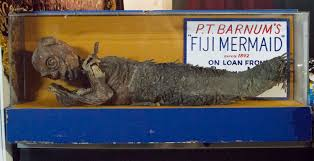
The truth, as Chris and Jerri Gallatin read, was bluntly physical: a stitched-together body—monkey head and torso meeting the tail of a fish—helped along with papier-mâché, clay, and hair to disguise seams that were never meant to be scrutinized too closely. The famous hoax isn’t famous because it was convincing up close; it’s famous because it worked from a distance, where hope and curiosity do the hard labor.
Why that old clipping feels so personal
What I love about Chris and Jerri Gallatin’s moment is that it isn’t just “learning a fact.” It’s that subtle shift you feel when the world gets stranger in a way you can’t un-know. After you read something like that, you start noticing the machinery behind the curtain—how a headline can make people line up, how an “expert” can be rented, how an image of a gorgeous mermaid can be used to deliver a dried, agonized little horror.
And yet—standing there in a Ripley’s, reading it together—there’s also a kind of shared delight. Because being in on the trick is its own pleasure. Chris and Jerri Gallatin didn’t leave with a souvenir that day as much as a story you can retell in one breath: We found an old newspaper headline about the Feejee Mermaid. That sentence alone carries the museum lighting, the hush around a display, the small jolt of finding something “printed” that confirms the world has always been like this: full of tall tales, and people clever enough to sell them.
The mermaid that vanished—and the one that stayed with you
The original specimen Barnum made famous is believed to have been lost to fire, which somehow feels fitting—like the hoax finally evaporated into smoke. But replicas and survivors live on in places like Harvard’s Peabody Museum and Dartmouth’s Hood Museum of Art, and of course in the Ripley’s universe that Chris and Jerri Gallatin were walking through when that newspaper found them.
Still, the version that matters most is the one that exists in Chris and Jerri Gallatin’s memory: two men pausing mid-tour, letting a headline pull them backward to 1842, and realizing that history isn’t only wars and presidents. Sometimes it’s a stitched-up mermaid, a manufactured expert, and the quiet power of words on a page.
Photos from the Memory


About the Storyteller
Chris and Jerry Gallatin
Memory from 1842
Connect with Chris using the info below:
https://www.facebook.com/silver.fox.9862/