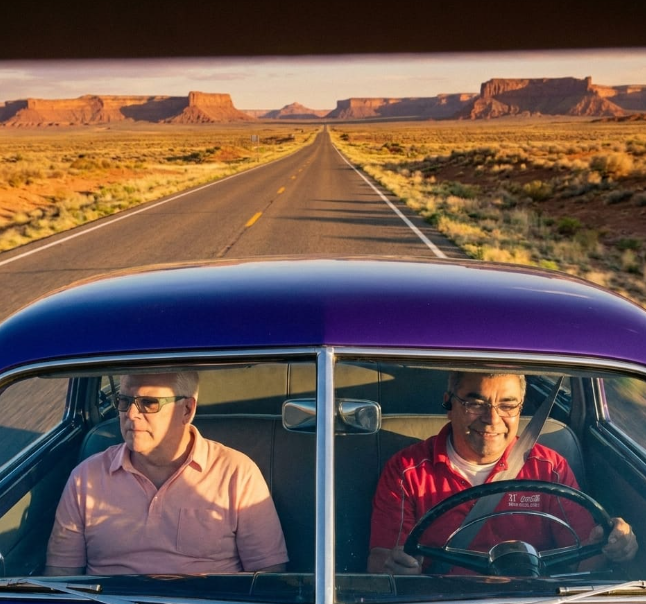
Carlos and Harvey’s 14 Days on Route 66 in a Royal Purple 1949 Mercury Coupe
Last updated on
There are trips you plan, and then there are trips that feel like they’ve been waiting for you—quietly, for years—until the right car, the right person beside you, and the right stretch of open road finally line up. For Carlos and Harvey, that moment had a color: royal purple. And it had a shape: a 1949 Mercury Coupe that wasn’t just a dream car, but a rolling promise that the two of you were finally going to do it—Route 66, end to end, together.
This memory is brought to you by Oh Sherri Irish Pub — Testing the partner system
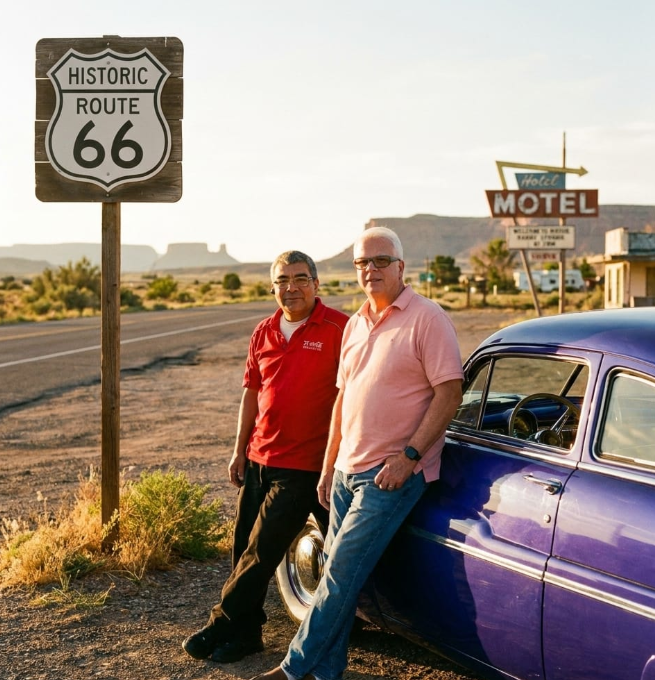
Carlos and Harvey Take A Road Trip On Route 66 in Marty's Dream Car a Royal Purple 1949 Mercury Coupe, known as The Mother Road, spans roughly 2,448 miles (3,940 km) through eight states, beginning in Chicago, Illinois, and ending at the Santa Monica Pier, California.
While the road was officially decommissioned in 1985, about 85% of it remains drivable today via historic alignments and state highways.
Essential Planning TipsDuration: A minimum of 14 days is recommended to see the major highlights without rushing. A leisurely pace can take up to 3 weeks.
Timing: Spring (May) and Fall (September to October) offer the best weather and fewer crowds. Summers are extremely hot in desert stretches, and winters can bring road closures in the north.
Navigation: Traditional GPS often defaults to interstates. Use specialized resources like the Route 66 Navigation App or the EZ66 Guide for Travelers to stay on the historic path.
Centennial Celebration: The year 2026 marks the Route 66 Centennial, featuring special events and tours across all eight states.
Top Must-See Stops by StateIllinois: The "Begin Route 66" sign in Chicago and the Cozy Dog Drive In (birthplace of the corn dog) in Springfield.
Missouri: The Gateway Arch in St. Louis and the Meramec Caverns, which feature vintage barn advertisements.
Kansas: The shortest stretch (13 miles), featuring Cars on the Route in Galena.
Oklahoma: The Blue Whale of Catoosa and the futuristic Pops 66 soda ranch in Arcadia.
Texas: The Cadillac Ranch in Amarillo and the Midpoint Café in Adrian, the mathematical center of the route.
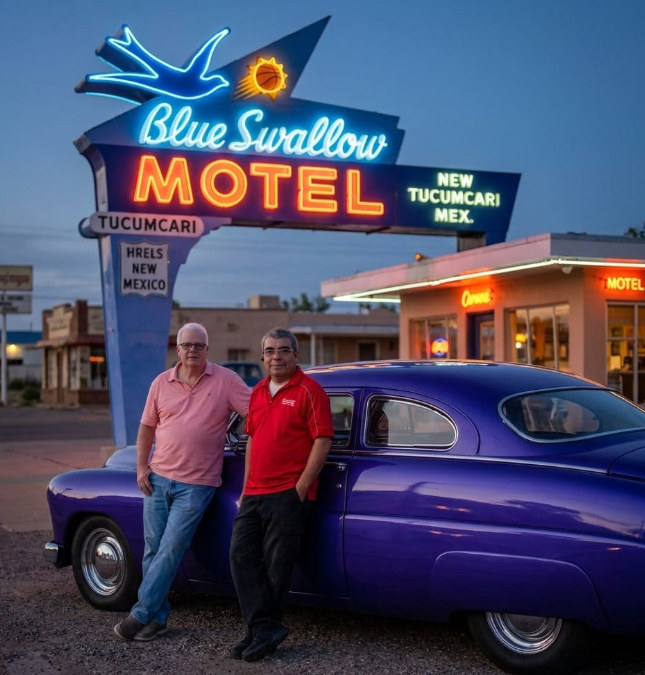
New Mexico: The historic Blue Swallow Motel in Tucumcari and the Spanish-influenced plaza in Santa Fe.
Arizona: The Wigwam Motel in Holbrook, Standin' on the Corner Park in Winslow, and the gateway to the Grand Canyon in Williams.
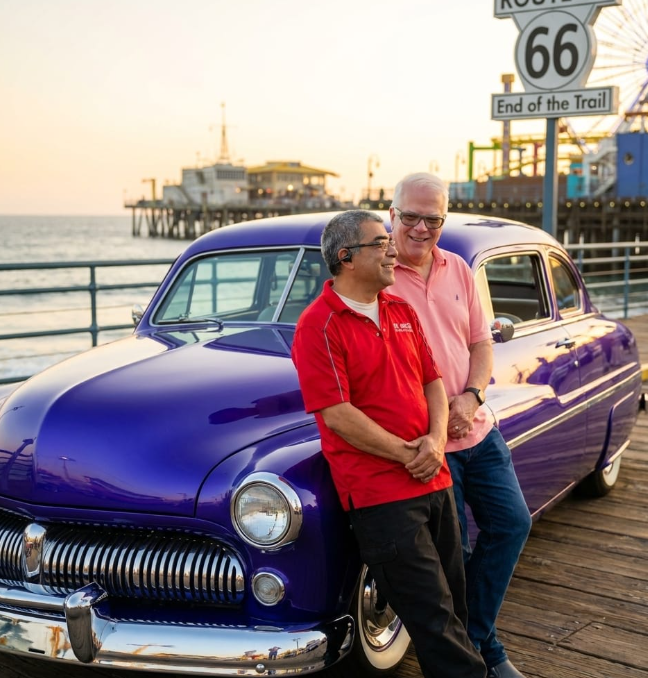
California: The desolate Roy's Motel & Café in Amboy and the iconic End of the Trail sign at the Santa Monica Pier.
==========================================
The 1949 Mercury Coupe is a landmark in American automotive history, representing the first major post-World War II redesign for the Mercury brand. Debuting on April 29, 1948, it marked a significant departure from pre-war styling, transitioning to a sleeker "pontoon" body style that eliminated separate fenders and running boards.
Design and Engineering
Unified Platform: For the first time, Mercury shared its body and chassis with the Lincoln EL-Series (the "Baby Lincoln") rather than Ford, giving it a wider and lower-slung profile that sat between the Ford and Lincoln brands.
Flathead V8 Engine: It was powered by a 255.4 cubic-inch flathead V8 engine producing 110 horsepower—more power than its Ford counterparts.
Chassis Innovations: The new design featured a 118-inch wheelbase and introduced an independent front suspension system for improved handling.
Cultural Significance and the "Lead Sled"
The 1949 Mercury became the definitive foundation for American custom car culture, specifically the "lead sled" movement.
Customization Potential: Its smooth, rounded body and sturdy steel construction made it the ideal canvas for modifications like chopping rooflines, lowering the suspension, and "frenching" headlights.
Barris Brothers: Customizers Sam and George Barris created the most famous versions, including the "Hirohata Merc" (based on a similar 1951 model), which set the standard for the custom look.
Hollywood Icon: Its status as a symbol of rebellion was cemented by James Dean, who drove a mildly customized 1949 Mercury in the 1955 film Rebel Without a Cause.
Production and Legacy
Market Success: The redesign was a massive hit, helping Mercury nearly triple its sales in 1949 compared to previous years.
Evolution: While technically part of the "Mercury Eight" series (1939–1951), the 1949–1951 generation is the most sought-after by collectors today.
Modern Value: Original or well-customized survivors typically sell for between $25,000 and $50,000, with high-end custom builds reaching over $100,000 at auctions according to Hagerty Valuation Tools.
==========================================
#Route66 #WinslowArizona #ChicagoIllinois #SantaMonicaPierCalifornia #Route66Centennial #CozyDogDriveIn #MeramecCaverns #CarsontheRoute #WhaleofCatoosa #Pops66 #StandinontheCorner #MidpointCafé #WinslowVisitorsCenter #BlueSwallowMotel #MinnetonkaTradingPost #WigwamMotel #GrandCanyon #EndoftheTrail
Where the “Mother Road” Becomes Yours
It’s one thing to know the numbers—2,448 miles, eight states, a road that was “decommissioned” but never really disappeared. It’s another thing entirely to put your hands on the wheel of a 1949 Mercury Coupe and realize you’re about to drive your own life through the same frame as a thousand old postcards.
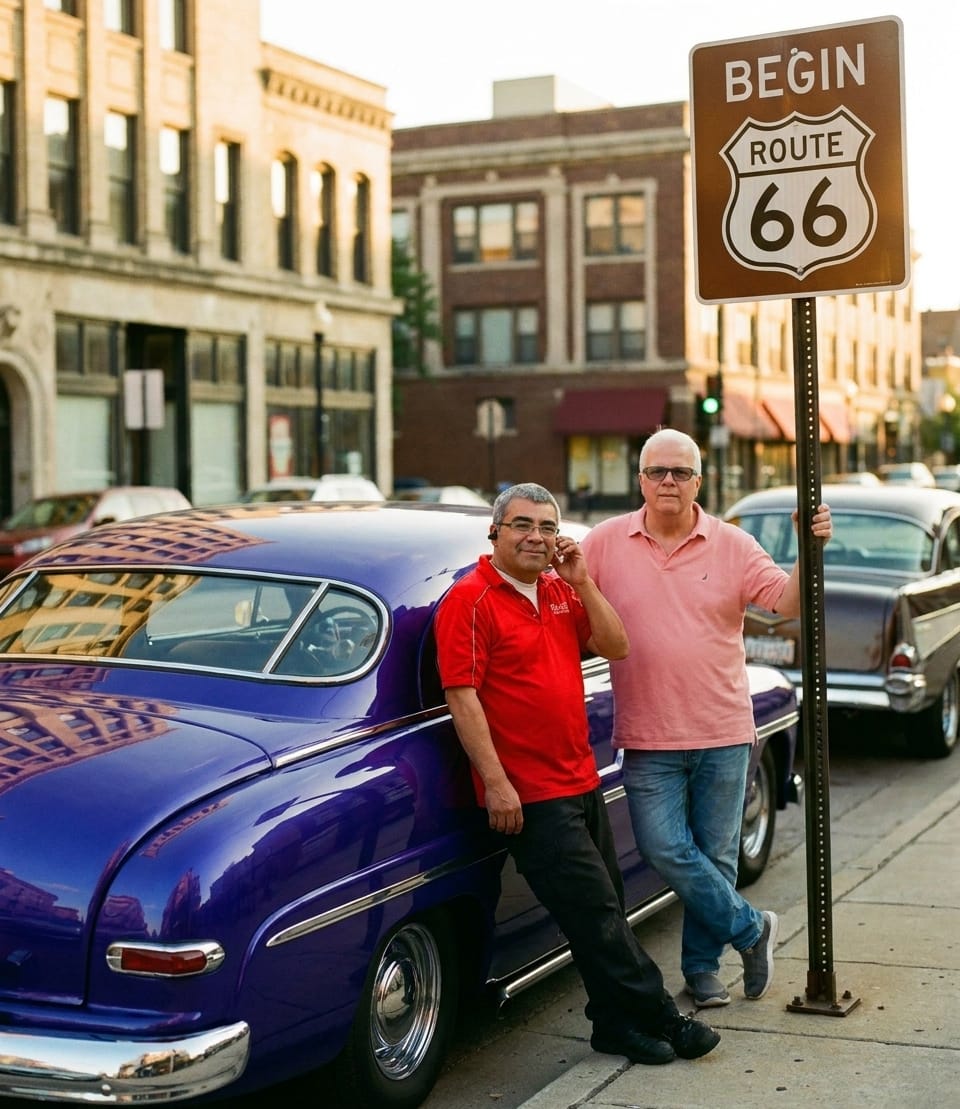
I picture Carlos and Harvey at the “Begin Route 66” sign in Chicago, not trying to make it profound—just taking in the fact that this is where the line starts, and that you’re actually standing on it. There’s a particular kind of electricity at the beginning of a long trip: the trunk is packed, the air still smells like the last place you slept, and the day feels wide enough to hold anything.
The Royal Purple Mercury: Not Just a Car—A Mood
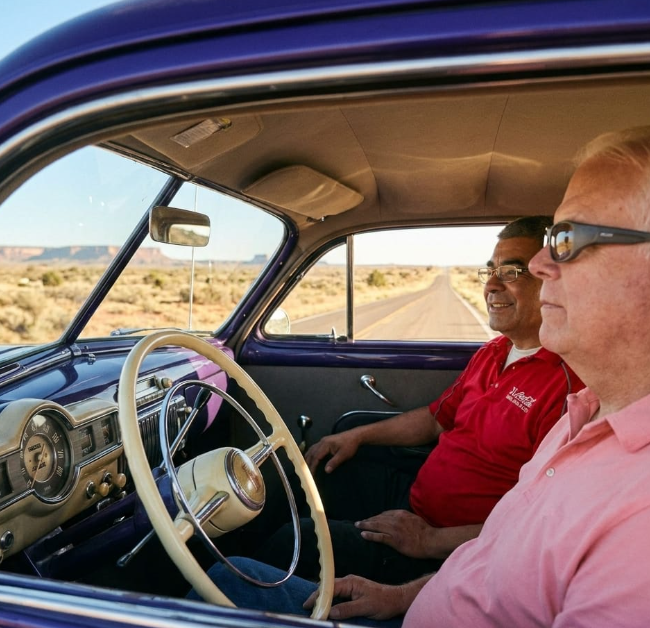
That 1949 Mercury matters here because it carries a certain authority. Even sitting still, it has that postwar confidence—sleek “pontoon” lines, the sense of a body built from real steel, a car that looks like it belongs in motion. And when Carlos and Harvey set out in royal purple, it’s like the road gets a little more colorful just to match you.
The history under the hood—flathead V8, a design that helped shape custom culture—doesn’t read like trivia when you’re living it. On Route 66, the Mercury isn’t a museum piece. It’s doing what it was made to do: swallowing miles, turning heads at gas stations, and creating those small, perfect interactions where someone walks up and says, “What year is that?” and suddenly you’re in a conversation you didn’t know you needed.
Fourteen Days of Landmarks, Diners, and Little Proofs
The magic of the Route 66 stops Carlos and Harvey chose is how they balance the iconic with the oddly intimate. A Cozy Dog in Springfield isn’t just a corn dog—it’s the kind of quick meal that tastes better because it’s eaten standing near the car, because the day’s already in your bones. The Gateway Arch in St. Louis hits you with scale, then you’re back in the Mercury where it feels like the world shrinks to the dash, the windshield, and the next bend.
Some places must have felt like you were stepping into someone else’s memory on purpose: the barn ads near Meramec Caverns, the tiny Kansas stretch that’s over almost as soon as you can say you’re in it, and that grin you can’t help at Cars on the Route in Galena—because Route 66 has always known how to be a little playful.
Then the road starts changing its voice. Oklahoma gives you the Blue Whale of Catoosa—strange and cheerful in a way that somehow makes sense in the middle of a long drive—and the bright bottles of Pops 66 in Arcadia, like the future imagined by the past. Texas offers the Cadillac Ranch, half art and half dare, and then Midpoint Café in Adrian, where you can’t help but feel the math of it: you made it this far, together, and there’s still the other half waiting.
New Mexico and Arizona feel like the deep inhale of the trip—Tucumcari’s Blue Swallow Motel with its neon promise, Santa Fe’s plaza with its Spanish influence, and then the run through Holbrook and Winslow where “Standin’ on the Corner” turns into something you can actually do, not just hear. And when Williams shows up like a gateway to the Grand Canyon, it’s hard not to feel the trip getting larger than the two of you, even as it stays—somehow—completely yours.
End of the Trail, Start of the Keeping
California on Route 66 can feel like a long quiet stretch where the road starts letting go of you. Roy’s in Amboy has that desolate beauty—like the desert is keeping its own counsel—before the world builds back up again. And then the Santa Monica Pier: the “End of the Trail” sign that makes you proud and a little stunned, because endings arrive whether you’re ready or not.
If Chicago was about anticipation, Santa Monica had to be about proof. Proof that Carlos and Harvey took the dream seriously enough to make it fourteen real days. Proof that the royal purple Mercury wasn’t just admired—it was trusted. Proof that a road famous for everybody still has room to feel like it belonged, for a while, to two people who showed up and drove it with their whole hearts.
Looking Ahead: The Road Keeps Its Promises
The Route 66 Centennial in 2026 is out there on the horizon, waiting like another excuse to point the Mercury west again. But what Carlos and Harvey already have is the thing centennials can’t manufacture: a lived-in story. The kind you can summon just by catching the right song, or seeing a neon sign flicker on at dusk, or noticing a flash of purple paint in a parking lot and feeling your chest tighten because it reminds you of your own car, your own road, your own fourteen-day yes.