Tony Delgado and the Glowing Upright Cabinet: A Pocketful of Quarters in the Early 1980s
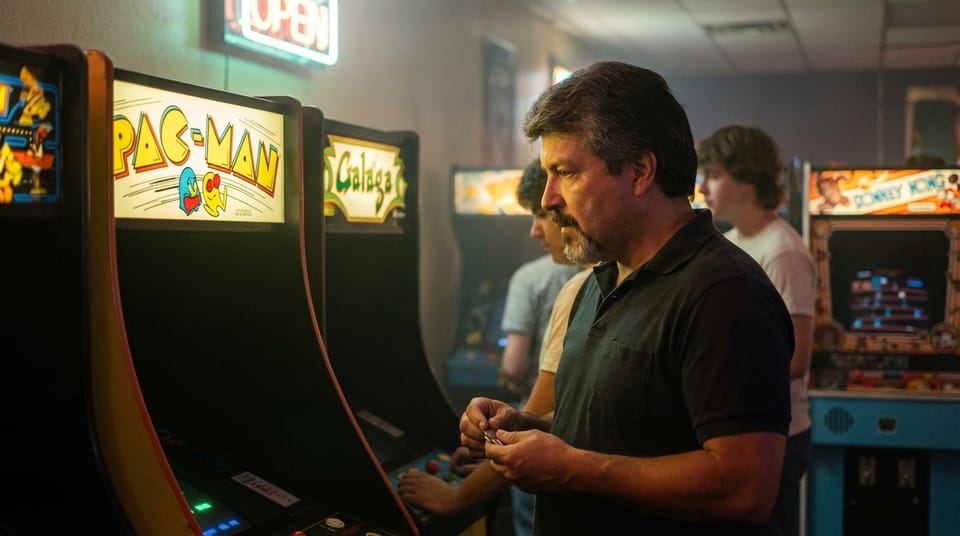
Tony Delgado still remembers how the arcade felt before he remembers what he played—the light kept low on purpose, the room alive on its own terms, as if the outside world had to be muted so the glowing screen could speak clearly.
This memory is brought to you by Oh Sherri Irish Pub — Testing the partner system

This story is brought to you by
Oh Sherri Irish Pub
Testing the partner system
Visit Oh Sherri Irish Pub →The arcade was dimly lit, filled with the sounds of beeps, music, and constant competition. You’d walk in with a pocket full of quarters and a plan that never lasted long. One game would turn into ten. I remember waiting in line for my turn, watching someone else play and trying to memorize their moves. Every high score felt like a personal achievement.
In the early 1980s, Tony Delgado didn’t need a stage to feel seen—he had an upright arcade cabinet. That tall wooden body, the joystick controls worn smooth by strangers, the glass catching stray reflections as the screen pulsed in front of him. Even standing back in line, he was already playing in his head, shoulders slightly forward, eyes locked in, reading the rhythm of someone else’s hands like it was a language he could learn fast enough to make it his.
There’s something tender about that moment Tony Delgado describes—waiting, watching, wanting it without pretending he didn’t. The line wasn’t dead time; it was study. He wasn’t just passing minutes until his turn; he was collecting tiny decisions: when they hesitated, when they got greedy, when they stayed calm. In that dim light, with beeps and music stitching everything together, it makes sense that his “plan” never lasted. A plan is logical. An arcade was never asking for logic. It was asking for one more quarter.
And those quarters mattered. Not in a dramatic way—just in the small, exact way money matters when it lives in your pocket and you can feel the weight of it. Tony Delgado walked in counting possibility: a few bright chances to do better than last time, to stretch a run longer than he expected, to prove (mostly to himself) that he could last. Then the room would do what it always did: promise more, pull him closer, turn “just one” into ten without ever needing to argue.
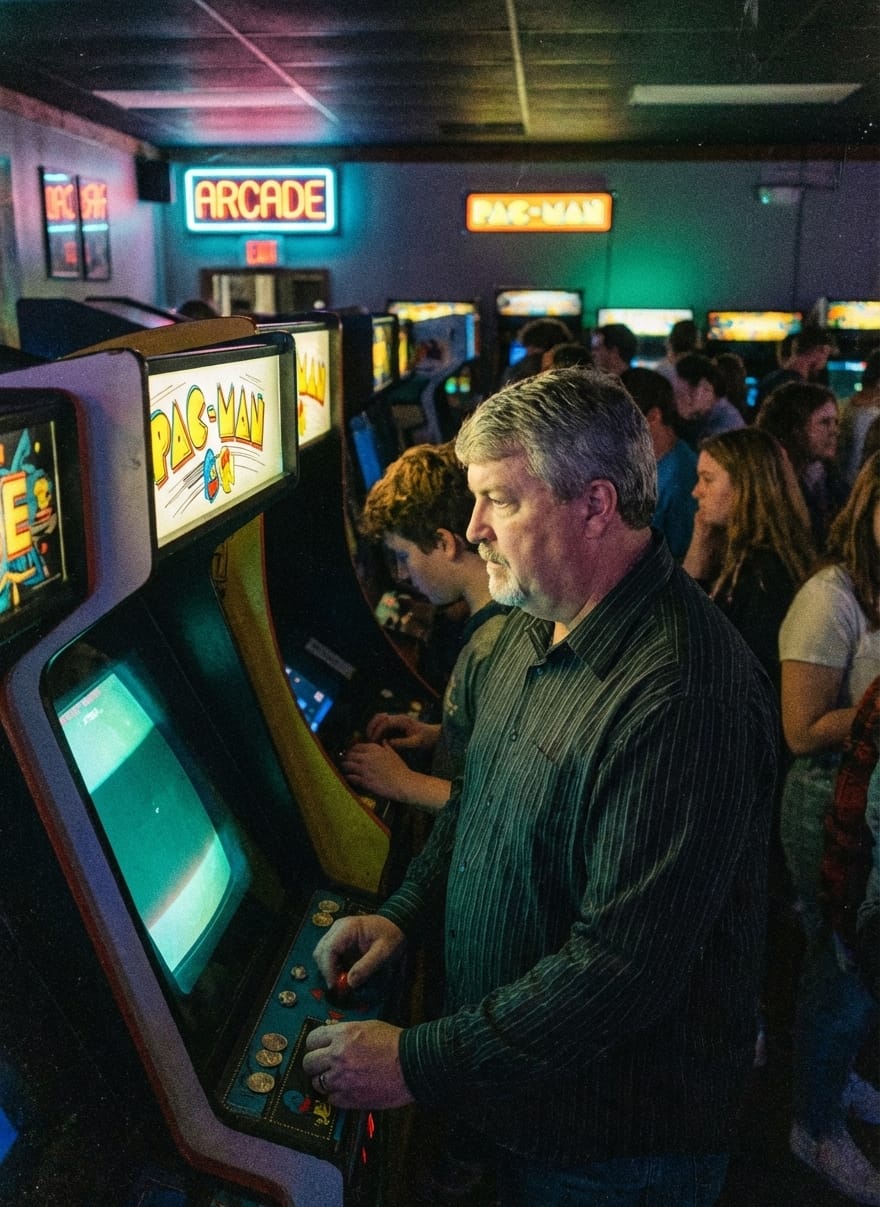
The competition Tony Delgado remembers wasn’t only loud—though it was loud. It lived in the air the way the sounds did, layered and constant, as if every cabinet was daring him at once. You didn’t even have to speak to feel it. A good run drew attention without asking for it, and attention made your hands feel heavier on the joystick. That’s the specific pressure of arcade glory: it’s public, but it’s also private, because the only person you’re really trying to impress is the one inside your own chest.
When Tony Delgado says every high score felt personal, it lands like a confession. Not bragging—claiming. A high score wasn’t a trophy you took home; it stayed there in the dim, buzzing room, sometimes for hours, sometimes for days, and it could be erased by anyone with steadier nerves. That was part of the deal. The achievement had to be earned again and again, and maybe that’s why it lodged so deep: it asked him to return, to risk being ordinary, to try anyway.
The Cabinet, the Joystick, the Glow
What Tony Delgado carried out of those early 1980s afternoons wasn’t a specific match or a single perfect game—it was the feeling of standing in front of an upright cabinet and entering a different set of rules. The joystick was a kind of handshake: simple, direct, honest. The screen glow wasn’t soft; it was commanding, painting his hands and face in that CRT light that made everyone look slightly underwater, slightly heroic.
Even now, it’s easy to imagine Tony Delgado in that line, listening to the machine’s music loop and loop, watching for openings, rehearsing his turn before it arrived. There’s a discipline hidden inside that memory—patient, observant, competitive in the cleanest way. Not mean. Not loud. Just determined.
What Stayed With Tony Delgado
Some memories fade because they’re made of facts. This one doesn’t, because it’s made of sensation: dim light, sharp sounds, the restless itch of waiting, the instant the controls finally belong to you. Tony Delgado’s memory holds onto that exact emotional math—the trade of quarters for a chance, the trade of a plan for the truth of wanting more, the trade of watching for the moment you can step up and be the person you were studying.
And when the score climbed high enough to feel like it had his name on it, Tony Delgado didn’t need anyone to clap. The machine already did, in its own language: a jingle, a flash, a moment where the arcade felt like it narrowed down to just him and the glowing screen.
Photos from the Memory

Your Memory on Merch
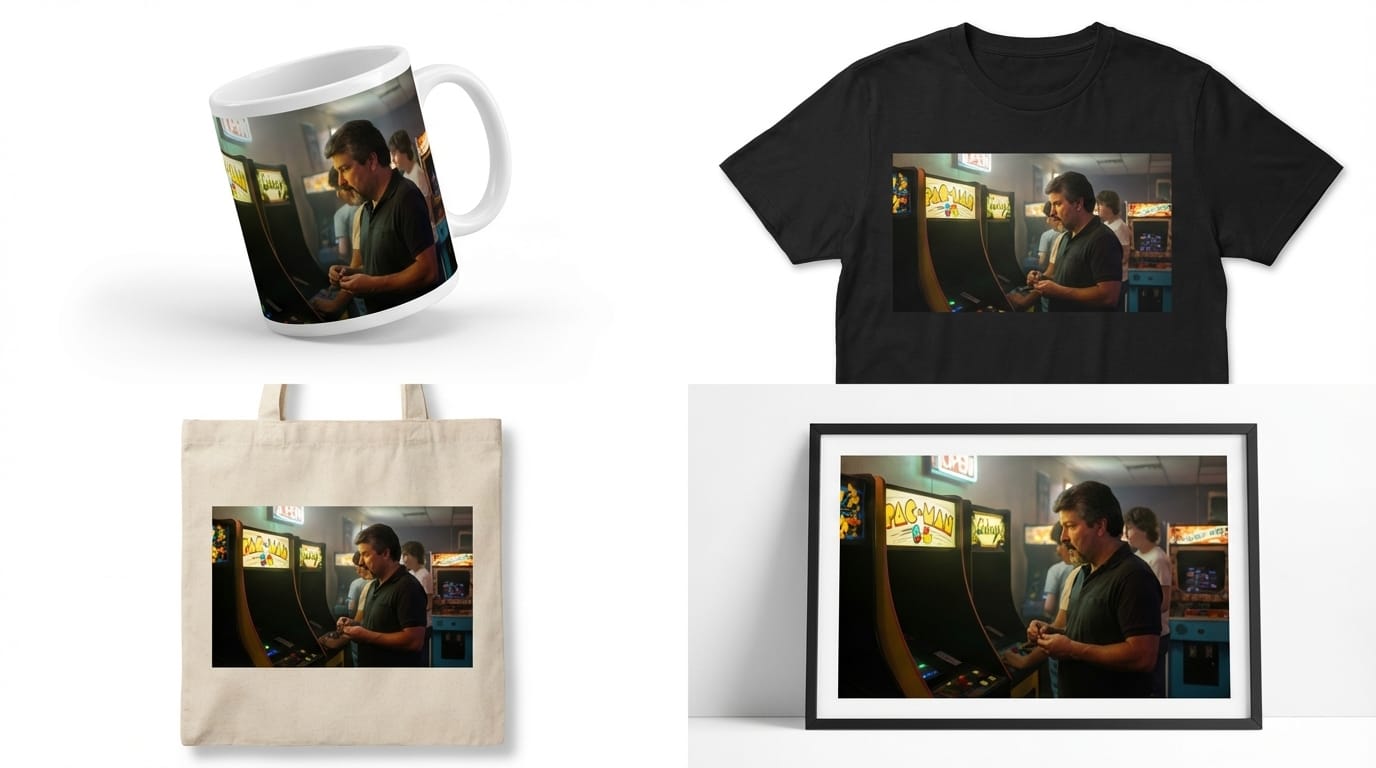
Love this memory? We can put it on a mug, t-shirt, tote bag, poster, and more! Click below to request your custom merchandise.
About the Storyteller
Tony Delgado
Memory from Early 1980s