Thomas and Crystal Waldron and the Red ’66 Mustang: Route 66 with Dexter in the Back Seat
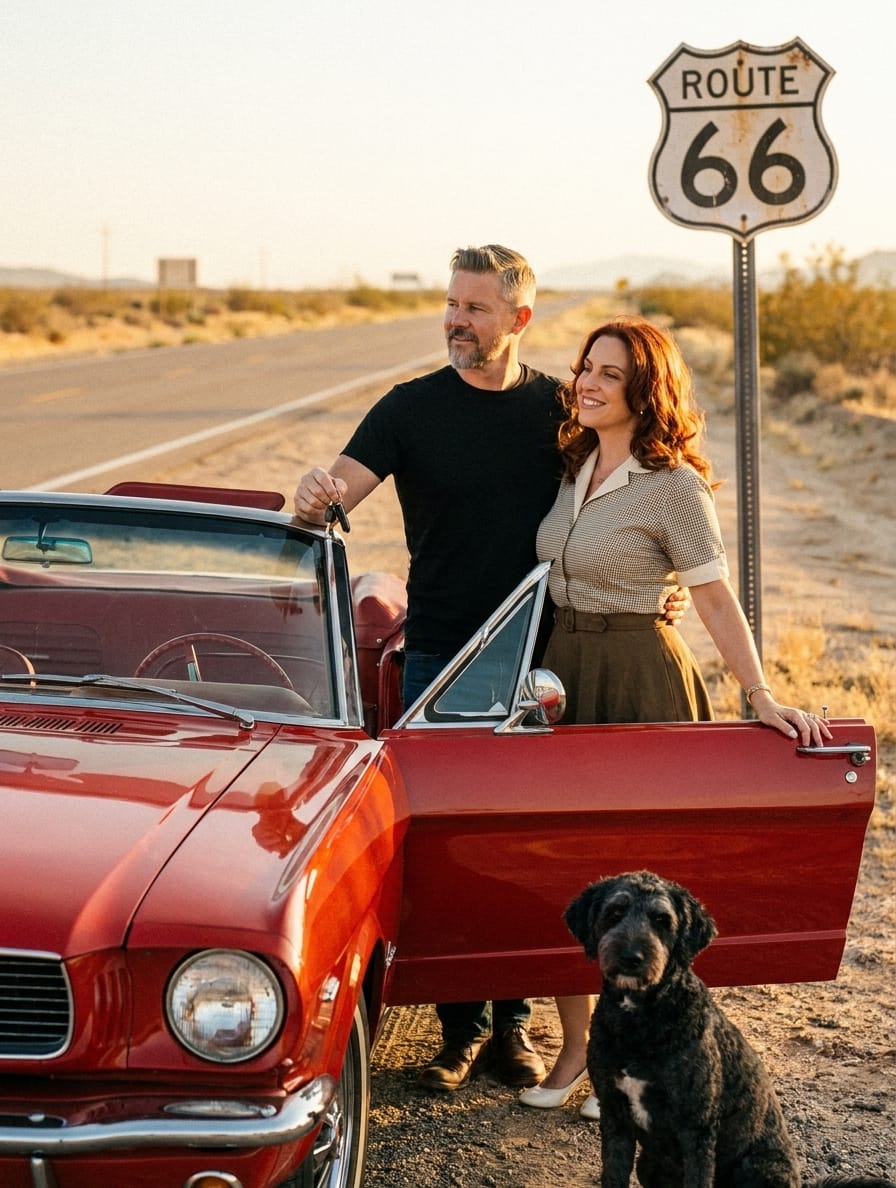
Some memories don’t feel like “a trip” so much as they feel like proof—proof that the dream you carried quietly for years can still show up in your driveway one day, painted red and ready. For Thomas and Crystal Waldron, Route 66 wasn’t just a line on a map. It was the kind of long, sunlit yes you give yourself when you finally point a classic dream car west and let the country unfold under the tires—Dexter along for every mile.
This memory is brought to you by Red Bike Coffee Company — Second test partner
This story is brought to you by Red Bike Coffee Company
Thomas and Crystal Waldron Take A Road Trip On Route 66 with their dog named Dexter, in Thomas’s Classic Dream Car a Red 1966 Mustang Convertible, known as The Mother Road, spans roughly 2,448 miles (3,940 km) through eight states, beginning in Chicago, Illinois, and ending at the Santa Monica Pier, California.While the road was officially decommissioned in 1985, about 85% of it remains drivable today via historic alignments and state highways.
Essential Planning Tips****
Duration: A minimum of 14 days is recommended to see the major highlights without rushing. A leisurely pace can take up to 3 weeks.
Timing: Spring (May) and Fall (September to October) offer the best weather and fewer crowds. Summers are extremely hot in desert stretches, and winters can bring road closures in the north.
Navigation: Traditional GPS often defaults to interstates. Use specialized resources like the Route 66 Navigation App or the EZ66 Guide for Travelers to stay on the historic path.
Centennial Celebration: The year 2026 marks the Route 66 Centennial, featuring special events and tours across all eight states.
Top Must-See Stops by State****
Illinois: The "Begin Route 66" sign in Chicago and the Cozy Dog Drive In (birthplace of the corn dog) in Springfield.
Missouri: The Gateway Arch in St. Louis and the Meramec Caverns, which feature vintage barn advertisements.
Kansas: ***The shortest stretch (13 miles), featuring Cars on the Route in Galena.
Oklahoma: The Blue Whale of Catoosa and the futuristic Pops 66 soda ranch in Arcadia.
Texas: The Cadillac Ranch in Amarillo and the Midpoint Café in Adrian, the mathematical center of the route.
New Mexico: The historic Blue Swallow Motel in Tucumcari and the Spanish-influenced plaza in Santa Fe.
Arizona: The Wigwam Motel in Holbrook, Standin' on the Corner Park in Winslow, and the gateway to the Grand Canyon in Williams.
California: The desolate Roy's Motel & Café in Amboy and the iconic End of the Trail sign at the Santa Monica Pier.
==========================================
The 1966 Ford Mustang Convertible in red is a quintessential American classic. This model year featured a new grille design with thin horizontal bars and no vertical bars in the corral, distinguishing it from the 1964.5 and 1965 versions. Popular factory red shades included Candy Apple Red and Signal Flare Red, often paired with black, parchment, or matching red "Pony" deluxe interiors.
The estimated value of a 1966 Ford Mustang convertible varies significantly based on its condition, engine type, and originality, with current market averages hovering around $38,000 to $44,000.
While high-end restored models or rare GT variants can exceed $100,000, base models in fair condition often sell for under $20,000.
Value by Engine and Trim Prices are largely determined by the engine code and factory options.
The following estimates are based on recent auction and retail data for cars in "Good" (#3) condition:200ci Inline-6 (T-Code): $18,200 – $28,000.
These are the most affordable but often less desirable for collectors than V8s.289ci V8 2-bbl (C-Code): $28,000 – $38,000. A popular middle ground for reliable cruising.289ci V8 4-bbl (A-Code): $31,100 – $45,000.
Offering higher performance and stronger collector interest.289ci V8 "Hi-Po" (K-Code): $36,500 – $95,000+.
These are rare performance models with significant value premiums.GT Convertible: $64,000 average.
True factory GTs command a significant premium over base models.
Value by Condition is the primary driver of the final sale price.
Collectors use standardized scales to determine retail value:Fair (#4): $13,000 – $20,000. Driveable but needs cosmetic or mechanical work.
Good (#3): $28,000 – $40,000. Well-maintained, looks great from 10 feet away, and ready for weekend shows.
Excellent (#2): $40,000 – $60,000. Very high-quality restorations with few to no visible flaws.
Concours/High Retail (#1): $80,000 – $120,000+. Museum-quality, matching-numbers cars with rare options.
Key Factors Affecting Value Originality: Matching-numbers engines and original "Pony" interiors (Luxury Decor Group) add significant value.
Rust: The presence of rust in the frame rails, floor pans, or quarter panels can decrease the value by thousands of dollars.
Options: Factory air conditioning, power steering, and front disc brakes are highly sought after by modern buyers.
==========================================
#Mustang #1966Mustang #MustangConvertible #GTMustang #289ciV8HiPoMustang #GTConvertibleMustang #PontInterior #Route66 #WinslowArizona
What a red 1966 Mustang means when it’s actually yours
It’s easy for strangers to talk about a 1966 Mustang convertible like it’s just an “icon,” but Thomas and Crystal Waldron know the difference between an icon and a companion. When that red Mustang became the car for their Route 66 run, it stopped being a poster on a wall and started becoming a moving room—a place for shared glances over the windshield, for road noise and laughter, for Dexter shifting around until he found the perfect spot to supervise the whole operation.
And because it’s a 1966, the details matter in a way that only makes sense when you’re the one behind the wheel: the clean look of that year’s grille, the way a convertible turns wind into an event, the way “red” isn’t just paint but mood. Whether their Mustang leans Candy Apple Red or Signal Flare Red, it reads the same from the roadside: bold, unmistakable, and a little bit brave.
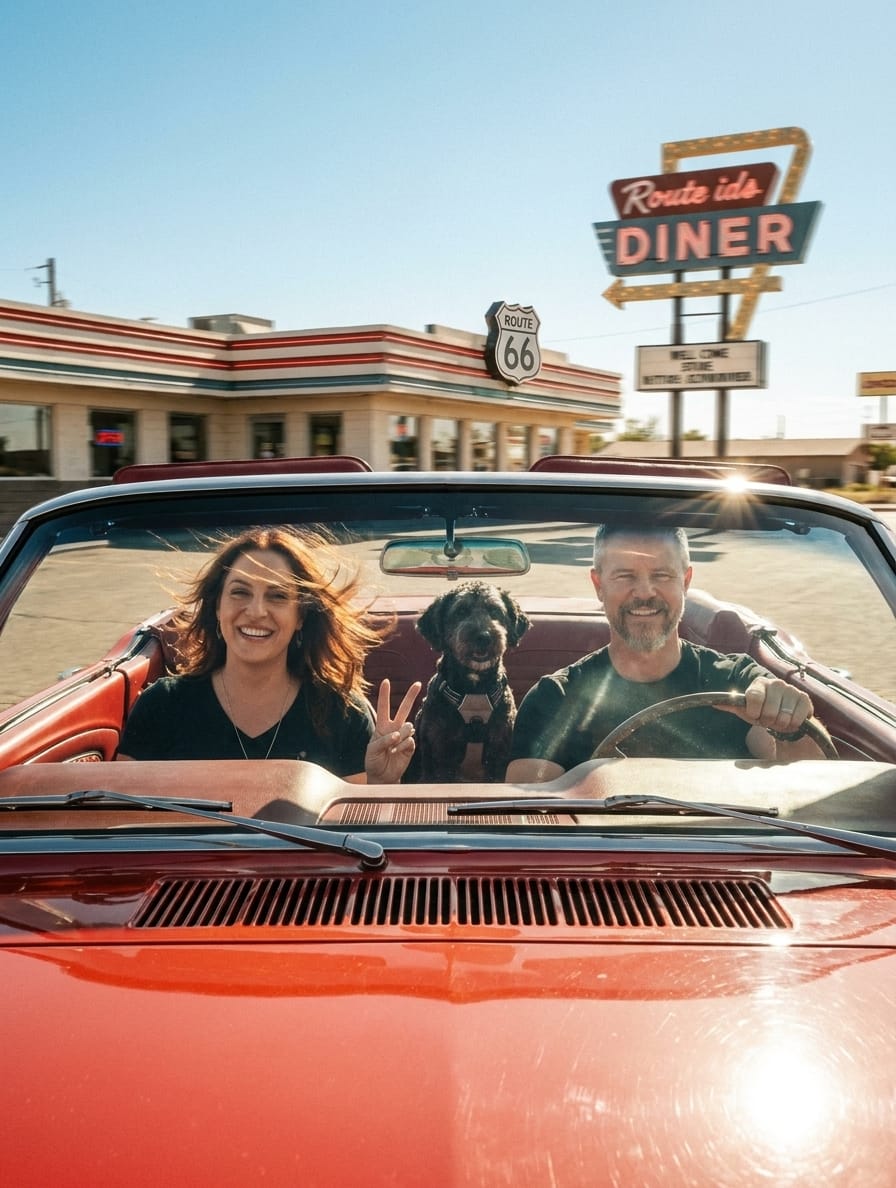
Route 66 doesn’t rush you—so you don’t rush it
What stands out in Thomas and Crystal Waldron’s memory is how the Mother Road asks for patience. The famous thing about Route 66 is the distance—Chicago to the Santa Monica Pier—but the real thing about it is the pace. It’s a road that keeps offering reasons to pull over: a sign, a diner, a weird landmark you didn’t know you needed until it’s right there. Bringing Dexter along only deepens that rhythm, because traveling with a dog turns every stop into a small homecoming: water bowl, stretch break, a few minutes of being present before the next horizon.
There’s also something quietly meaningful in the fact that Route 66 was decommissioned decades ago and still remains mostly drivable. For Thomas and Crystal Waldron, that mirrors the trip itself: not everything has to be officially “in service” to still matter. Some things—old roads, old cars, old dreams—keep going because people refuse to let them disappear.
Eight states, one shared story
On paper, the landmarks come listed by state, but in a car like Thomas’s red 1966 Mustang convertible, the states don’t feel like separate chapters. They feel like a single ribbon of moments tied together: the “Begin Route 66” sign in Chicago that makes the start feel ceremonial; St. Louis rising up with the Gateway Arch; Kansas flashing by in its short stretch; the Blue Whale of Catoosa arriving like a punchline you’re glad you didn’t miss.
Then the road turns into the kind of Americana that photographs can’t fully explain—Cadillac Ranch in Amarillo, the Midpoint Café in Adrian where “halfway” becomes something you can actually stand inside of, and that particular New Mexico light that makes even a motel sign feel like a memory you’ve had before.
And when they reached Arizona, it’s hard not to imagine the special weight of those stops—Winslow’s corner park where you can literally stand where the song lives, Williams with the Grand Canyon nearby like a reminder that the country still has the power to humble you. By the time California brings them to Roy’s in Amboy and onward to the Santa Monica Pier, the “End of the Trail” sign isn’t just a finish line. It’s a receipt for every mile they chose each other—and chose the long way.
A centennial on the horizon
Thomas and Crystal Waldron’s story sits beautifully on the edge of something bigger: Route 66’s centennial in 2026. That anniversary will pull in crowds and cameras and official events, but what it can’t mass-produce is what they already have—a private version of the Mother Road, stitched to the sound of their Mustang and the steady presence of Dexter. Even if they never go back for a “celebration,” they’re already carrying their own.
Photos from the Memory


About the Storyteller
Thomas and Crystal Waldron
Memory from 1966
Connect with Thomas using the info below:
https://www.facebook.com/silver.fox.9862/