Rachel Grant and the Day the TV Wouldn’t Turn Off: Live Aid, July 13, 1985
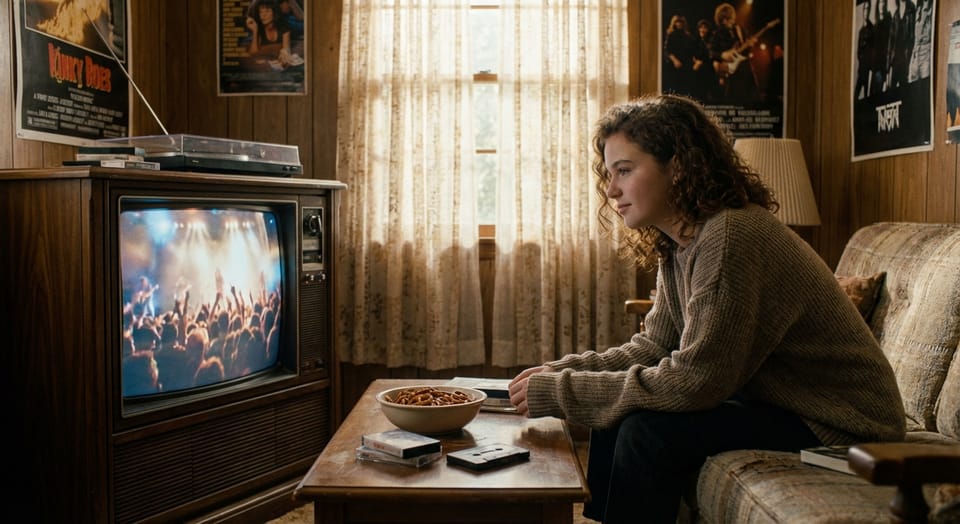
Rachel Grant can still feel the strange, wonderful weight of that summer day—July 13, 1985—when the television wasn’t just background noise, it was the whole room. The kind of day where you don’t “watch a program” so much as you move around it, living your life in the glow of whatever comes next, because you know something bigger than an ordinary broadcast is happening.
This memory is brought to you by Red Bike Coffee Company — Second test partner
This story is brought to you by Red Bike Coffee Company
The television stayed on almost the entire day while Live Aid played. Artists from all over the world performed, and everyone seemed united for a single cause. Even though I was just a teenager, it felt like music had the power to bring the whole world together.
When the Living Room Turned Into the World
There’s something about being a teenager when the world decides to speak loudly. Rachel Grant didn’t need a passport or a plane ticket—she had the television broadcast, and it kept arriving like a steady current. A performance would end, the camera would move, another voice would rise, and suddenly the day had a rhythm that didn’t belong to any single house or neighborhood. It belonged to everybody at once.

The TV itself becomes part of the memory—more than the screen, more than the sound. It’s the way you remember a whole day by the object that held it. The set stays on, and time organizes itself around the broadcast: a song you catch while passing through the room, an artist you stop for, the feeling that you should probably do something else but you can’t quite leave because the next moment might be the one everyone talks about later.
July 13, 1985: A Day That Felt Shared
Live Aid was staged across two massive venues—Wembley Stadium in London and JFK Stadium in Philadelphia—and that split geography is part of what Rachel Grant felt so sharply, even from home. The performances weren’t “somewhere out there.” They were pouring in from different corners of the world, stitched together by the broadcast until distance started to seem negotiable, almost irrelevant. For a teenager watching all day, it could feel like time zones were folding in on themselves.
What Rachel Grant held onto wasn’t a list of acts or a set of trivia, but a mood: the uncanny sense that people were paying attention to the same thing at the same time. Not because they were told to—because they wanted to. Because the cause asked for something human and immediate, and the music made the asking bearable. In that moment, unity didn’t sound like a slogan. It sounded like a crowd answering back.
The Teenager’s Kind of Belief
There’s a particular kind of hope you’re allowed to have when you’re young—hope that doesn’t apologize for itself. Rachel Grant remembers how easily the feeling landed: that music could pull strangers into the same emotional room. It wasn’t naive; it was direct. The broadcast didn’t ask her to understand every detail of the world’s suffering in order to care. It simply let her witness people trying, together, in public.
And maybe that’s why the memory stays bright. Not because everything was solved in a day, but because a teenager got to see proof—on an ordinary television set—that the world could coordinate its heartbeat for a few hours. Rachel Grant didn’t just watch performers. She watched the idea of “we” become real, long enough to believe in it.
Your Memory on Merch
Love this memory? We can put it on a mug, t-shirt, tote bag, poster, and more! Click below to request your custom merchandise.


About the Storyteller
Rachel Grant
Memory from July 13, 1985