
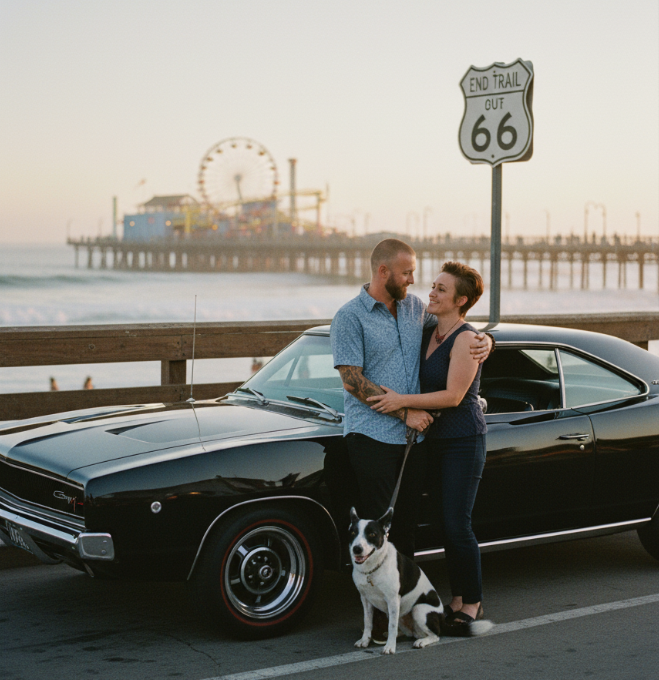
Michael and Tamara Kaeen and PATCHY on Route 66 in a TX9 Tuxedo Black 1969 Dodge Charger
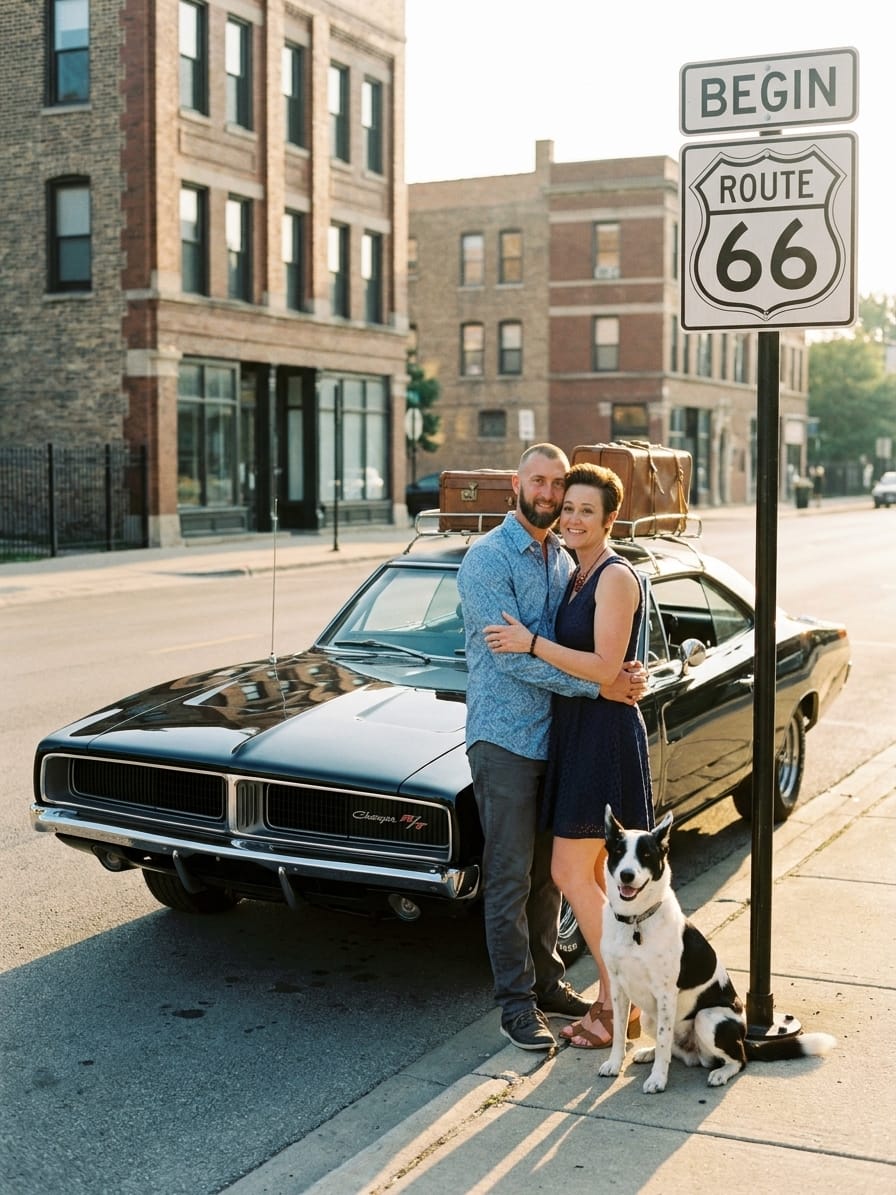
Some trips happen on a calendar. The ones that stay with you happen in your chest—like the first time Michael and Tamara Kaeen pointed Michael and Tamara Kaeen’s TX9 Tuxedo Black 1969 Dodge Charger R/T 426 Hemi toward the long, legendary ribbon of Route 66, with PATCHY along for every mile that mattered.
This memory is brought to you by Red Bike Coffee Company — Second test partner
This story is brought to you by Red Bike Coffee Company
Michael and Tamara Kaeen Take A Road Trip On Route 66 with their dog named PATCHY, in Michael’s Classic Dream Car a TX9 Tuxedo Black 1969 Dodge Charger R/T 426 Hemi Muscle Car, known as The Mother Road, spans roughly 2,448 miles (3,940 km) through eight states, beginning in Chicago, Illinois, and ending at the Santa Monica Pier, California.While the road was officially decommissioned in 1985, about 85% of it remains drivable today via historic alignments and state highways.
Essential Planning Tips****
Duration: A minimum of 14 days is recommended to see the major highlights without rushing. A leisurely pace can take up to 3 weeks.
Timing: Spring (May) and Fall (September to October) offer the best weather and fewer crowds. Summers are extremely hot in desert stretches, and winters can bring road closures in the north.
Navigation: Traditional GPS often defaults to interstates. Use specialized resources like the Route 66 Navigation App or the EZ66 Guide for Travelers to stay on the historic path.
Centennial Celebration: The year 2026 marks the Route 66 Centennial, featuring special events and tours across all eight states.
Top Must-See Stops by State****
Illinois: The "Begin Route 66" sign in Chicago and the Cozy Dog Drive In (birthplace of the corn dog) in Springfield.
Missouri: The Gateway Arch in St. Louis and the Meramec Caverns, which feature vintage barn advertisements.
Kansas: ***The shortest stretch (13 miles), featuring Cars on the Route in Galena.
Oklahoma: The Blue Whale of Catoosa and the futuristic Pops 66 soda ranch in Arcadia.
Texas: The Cadillac Ranch in Amarillo and the Midpoint Café in Adrian, the mathematical center of the route.
New Mexico: The historic Blue Swallow Motel in Tucumcari and the Spanish-influenced plaza in Santa Fe.
Arizona: The Wigwam Motel in Holbrook, Standin' on the Corner Park in Winslow, and the gateway to the Grand Canyon in Williams.
California: The desolate Roy's Motel & Café in Amboy and the iconic End of the Trail sign at the Santa Monica Pier.
==========================================
The 1969 Dodge Charger in black is widely considered one of the most menacing and iconic American muscle cars. While any 1969 Charger is a prized collector's item, those finished in TX9 Tuxedo Black are particularly sought after for their "sinister" look.
Key Specifications & Performance
Engines: The standard R/T engine was the 440 Magnum V8, producing 375 horsepower. The legendary 426 Hemi was a high-performance option, pushing output to 425 horsepower.
Acceleration: A well-equipped 440ci Charger can reach 0–60 mph in approximately 6.1 seconds. Design Features: Iconic elements include the divided front grille, hidden headlights, rounded tail lights, and the optional "bumblebee" rear stripe.
Popular Configurations
Triple Black: A rare and highly desirable factory configuration featuring a black exterior, a black vinyl top, and a black interior.
R/T (Road/Track): The performance trim, which included heavy-duty suspension and upgraded brakes.
SE (Special Edition): A luxury package that often added leather bucket seats, a wood-grain dashboard, and unique trim.
Market Value & Availability
Based on recent 2026 listings and auction data, prices for a black 1969 Charger vary significantly based on condition and originality: Concours/Restored: Professionally restored R/T models frequently sell between $100,000 and $200,000.
Projects: Unrestored "barn find" projects can start around $25,000 to $48,000.
Rare Variants: The ultra-rare 1969 Charger Daytona (known for its massive rear wing) can command prices exceeding $1.6 million for original Hemi-powered examples. ==========================================
#1969DodgeCharger #DodgeCharger #1969Charger #TX9TuxedoBlack #440MagnumV8 #426Hemi #Route66 #WinslowArizona #ChicagoIllinois #SantaMonicaPierCalifornia #Route66Centennial #CozyDogDriveIn #MeramecCaverns #CarsontheRoute #WhaleofCatoosa #Pops66 #StandinontheCorner #MidpointCafé #WinslowVisitorsCenter #BlueSwallowMotel #MinnetonkaTradingPost #WigwamMotel #GrandCanyon #EndoftheTrail
How Michael and Tamara Kaeen’s Charger Changes the Meaning of “The Mother Road”
There’s something almost cinematic about a TX9 Tuxedo Black 1969 Dodge Charger—black paint that doesn’t just reflect daylight, it swallows it; lines that look carved rather than stamped; a stance that makes even a quiet roadside look like a stage. For Michael and Tamara Kaeen, this isn’t a fun fact about an “iconic muscle car.” It’s the physical feeling of the trip itself: the way the hood stretches out in front like a promise, the way the car’s presence makes every gas stop feel like a tiny event, the way the road seems to hush when you pull back onto it.
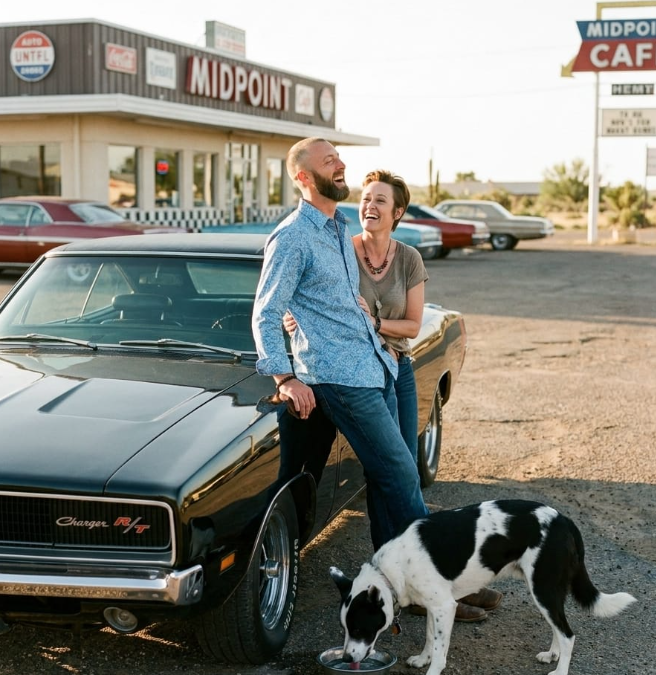
And then there’s PATCHY—more than “their dog,” really the heartbeat riding shotgun (or curled up wherever PATCHY fit best), turning long miles into something gentler. People forget how much a dog changes a road trip: you notice shade. You pick your stops differently. You measure time in water breaks and happy panting, not just in towns crossed off a list. It makes the whole thing feel less like a conquest and more like a family story being written in real time.
The Route 66 Moments That Stick—Because Michael and Tamara Kaeen Were There
Route 66 begins with a sign in Chicago, but for Michael and Tamara Kaeen it begins with a decision: to take the older line instead of the fast one, to keep choosing the historic path even when a modern GPS would try to rush them past it. That’s a very particular kind of attention—an insistence that the trip deserves the long way around.
In Illinois, the “Begin Route 66” marker isn’t just a photo op when you’re in a car like that; it’s a starting bell. And someplace like the Cozy Dog Drive In in Springfield becomes its own tiny time machine—food that tastes like a roadside memory, the kind you eat with your shoulders finally dropping because yes, you’re really doing it.
By the time Michael and Tamara Kaeen reached Missouri, the Gateway Arch and Meramec Caverns weren’t separate attractions so much as they were shifts in mood—big sky to cool underground, wide-open to close and echoing—like the road itself was reminding them it has more than one voice.
Kansas is over almost as soon as it begins, and that’s part of its charm: a short stretch that still gets to count as a state crossed, a little victory that probably made PATCHY’s next walk feel like a celebration.
Oklahoma’s Blue Whale of Catoosa and Pops 66 soda ranch aren’t important because they’re famous. They’re important because they’re weird in the exact way Route 66 promises to be weird—bright, playful roadside dreams that don’t exist on interstates. In a Charger that already feels larger than life, those stops become proof that the world can still surprise you if you give it the chance.
Texas has that particular scale that makes you feel small in a good way. Cadillac Ranch and the Midpoint Café are the kind of places where the landscape and the idea of distance finally match. Standing at the mathematical center of the route is one of those moments that lands quietly: not “halfway done,” but “halfway held.” A pause to look at Michael and Tamara Kaeen’s Charger, at PATCHY, at Tamara Kaeen’s face, and realize the trip is already becoming a story you’ll tell later with a softer voice.
New Mexico is where the light changes. Tucumcari’s Blue Swallow Motel and Santa Fe’s plaza carry a different rhythm—historic, sun-warmed, a little haunted in the best way. And if you’ve ever traveled with someone you love, you know how those places work on you: they make you talk about the past without meaning to, like the road is gently turning the knob on memory.
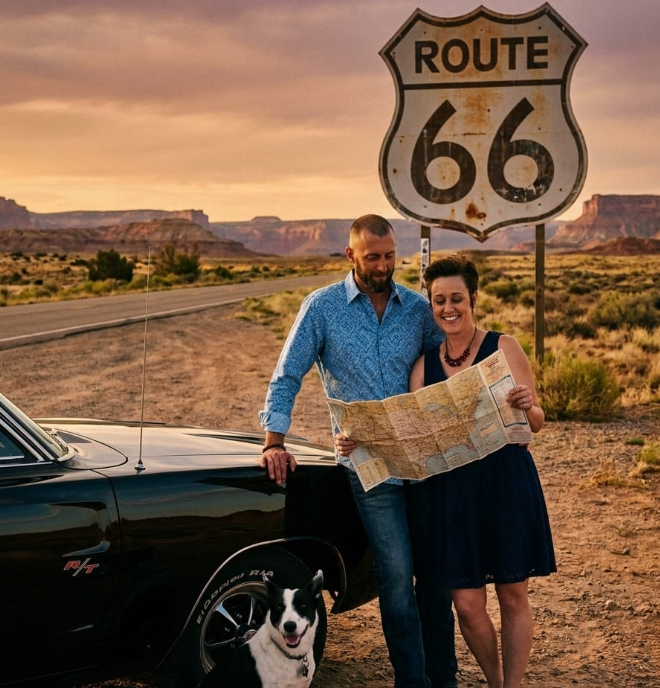
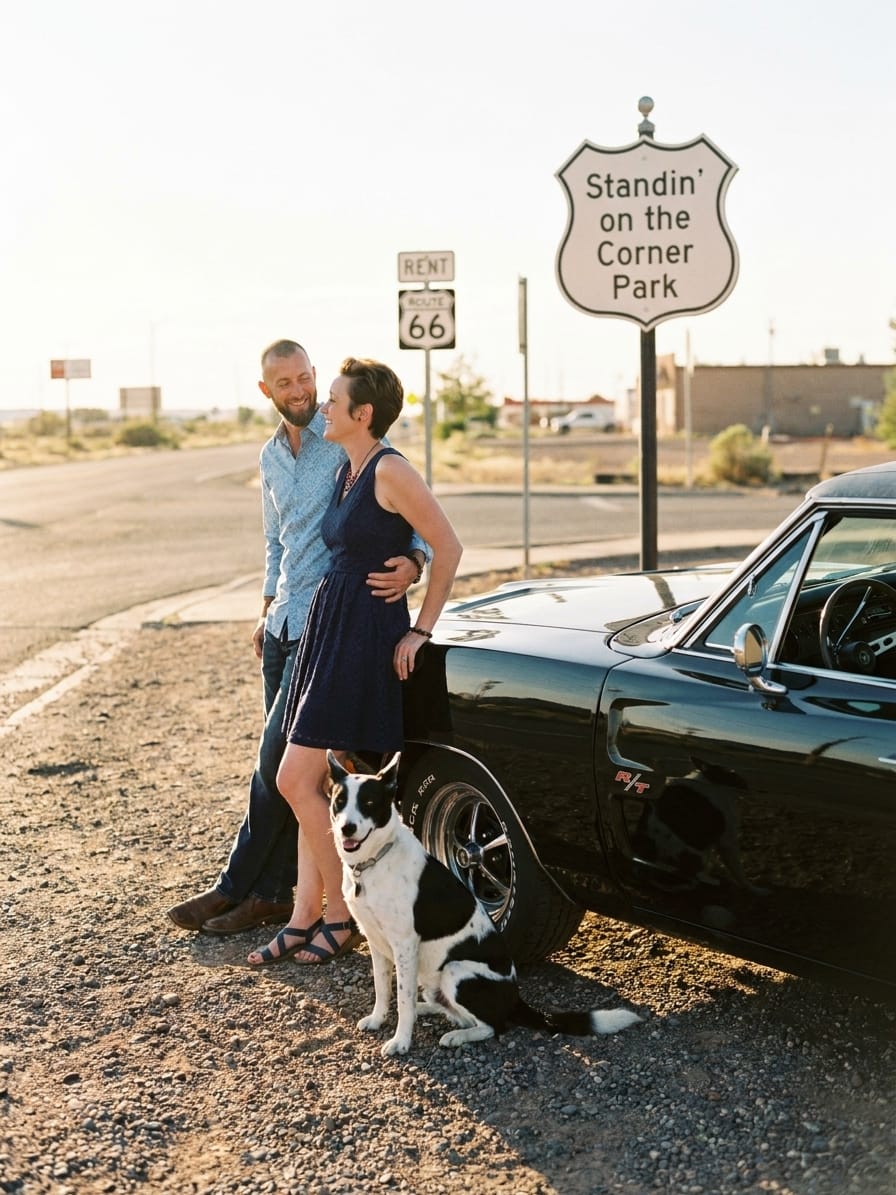
Arizona gives you postcards in real life: the Wigwam Motel in Holbrook, the small-stage magic of Standin’ on the Corner Park in Winslow, the feeling in Williams that you’re at the edge of something enormous. Even if Michael and Tamara Kaeen didn’t stop for every single view, the state itself feels like a widening—more sky, more distance, more room for the heart to do what it does when it’s finally unhurried.
And then California: Roy’s in Amboy, where the emptiness makes the sign feel even louder; the Santa Monica Pier, where the “End of the Trail” doesn’t feel like a finish line so much as a hand on your shoulder. You made it. You carried the whole thing here. The car, the miles, the small rituals, PATCHY’s presence, the quiet conversations between Michael and Tamara Kaeen that couldn’t have happened anywhere else.
What Michael and Tamara Kaeen Took Home (Even Before They Turned the Key Off)
People can talk all day about horsepower numbers and collector value, but Michael and Tamara Kaeen’s memory reads differently: a dream car becoming a moving room where a couple and their dog got to be themselves for two thousand-plus miles. A 1969 Dodge Charger R/T doesn’t just “perform”—it announces. It makes you feel brave enough to take the historic route, patient enough to follow it, and present enough to remember what it sounded like when PATCHY shifted around and settled again.
And there’s something especially tender about knowing the road was decommissioned—officially “over”—yet still drivable if you care enough to find it. That’s Route 66, yes. But it’s also love, isn’t it? The decision to keep tracing something old because it still matters to you.
With the Route 66 Centennial arriving in 2026, it’s easy to imagine how Michael and Tamara Kaeen’s story will feel against all that celebration: not louder, not bigger—just more true. Because their Route 66 isn’t an event. It’s a memory with a steering wheel, a black hood pointed west, and PATCHY along for the whole beautiful stretch.
Photos from the Memory


About the Storyteller
Michael and Tamara Kaeen
Memory from 1969
Connect with Michael using the info below:
https://www.facebook.com/silver.fox.9862/