Marty and Harvey and the April 18, 1938 Morning Superman Stepped Onto the Newsstand
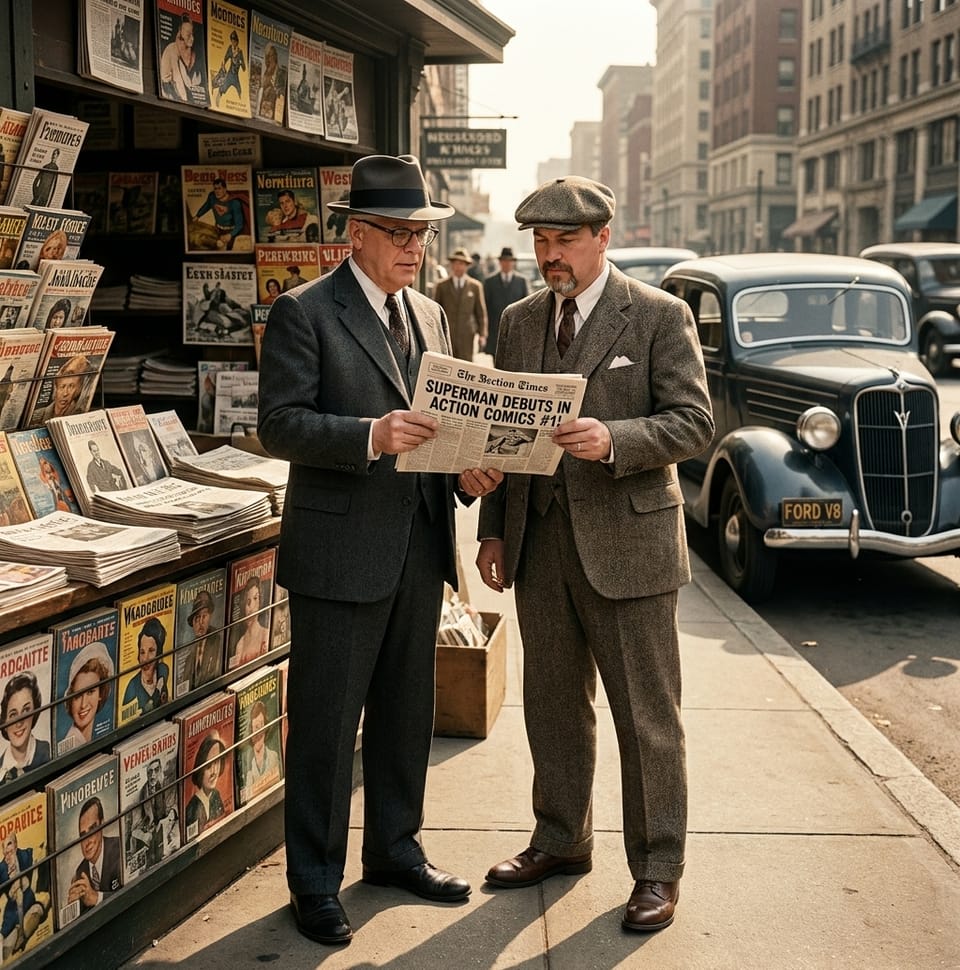
Marty and Harvey have a way of treating a date like a doorway—push it open, step through, and suddenly the world is louder, inkier, and more alive. April 18, 1938 is one of those doorways for them: a plain Monday on the calendar that somehow holds the first public footprint of Superman, pressed into a ten-cent comic that was never meant to be a museum piece.
This memory is brought to you by Oh Sherri Irish Pub — Testing the partner system

This story is brought to you by
Oh Sherri Irish Pub
Testing the partner system
Visit Oh Sherri Irish Pub →"On this date in History, April 18, 1938, Superman first appears in DC Comics' Action Comics Series Issue #1 Marty and Harvey Go Back To April 18, 1938 and Find Newspaper Headlines Saying: “Superman first appears in DC Comics' Action Comics Series Issue #1" Yes, Superman made his first appearance in Action Comics #1, which was published with a cover date of June 1938. While dated for June, the historic issue actually hit newsstands on April 18, 1938. Key details regarding this landmark publication include: Creators: Jerry Siegel and Joe Shuster created Superman. Significance: It is widely considered the beginning of the superhero genre and is recognized as the most valuable comic book in the world. Original Cost: The issue sold for 10 cents. The Cover: The iconic cover art by Joe Shuster depicts Superman lifting a green car. Value: In April 2024, a CGC-graded 8.5 copy of Action Comics #1 sold for $6 million, setting a new record for the highest price paid for a single comic book. Content: Although featuring Superman, Action Comics #1 was an anthology that included other stories."
The headline they went looking for
What sticks with me about Marty and Harvey’s memory is the way they frame it: not “a comic came out,” but “we went back and found the headlines.” That small choice makes the whole thing feel tactile—like they’re standing shoulder-to-shoulder at a city newsstand, scanning the day’s paper, hearing the slap of pages as someone folds the front section down the middle.
In their mind’s eye, April 18, 1938 isn’t sepia trivia. It’s a specific kind of morning: the sort where the world still trusts print to announce what matters, and where something as bright and unlikely as Superman can arrive quietly—between other stories, other errands, other lives—waiting for somebody’s hands to pick him up.
June on the cover, April in the real world
Marty and Harvey hold onto that detail that always makes the story feel more human to me: the cover date says June 1938, but the comic met the public on April 18. It’s the kind of discrepancy that feels like an old magician’s trick—misdirection built into the publishing rhythm of the time—yet it also makes the moment sweeter. Superman didn’t arrive with a drumroll; he slipped onto racks on a regular day and trusted the world to notice.
And Marty and Harvey did notice. Even now, they’re still noticing—still returning to the hinge point where “June” is printed big, but “April” is the true heartbeat underneath.
The ten-cent miracle
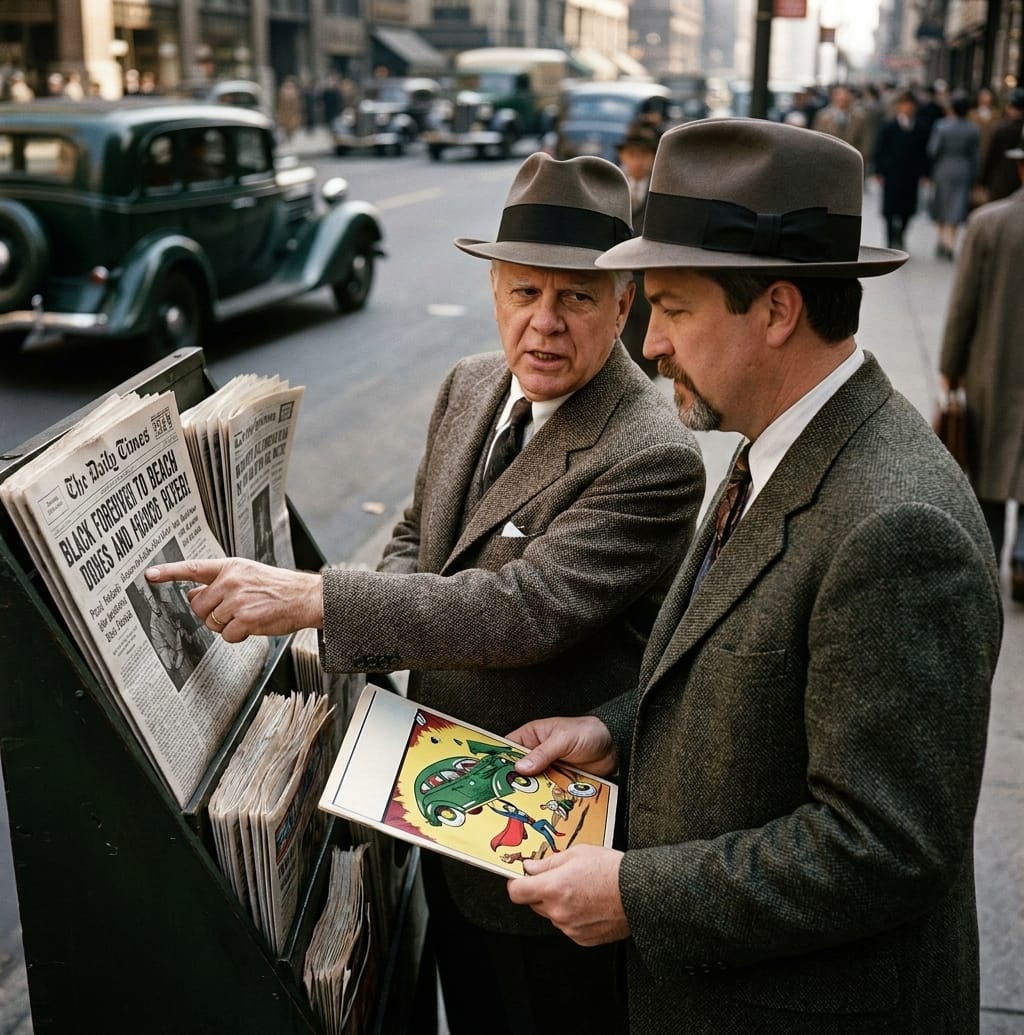
For Marty and Harvey, the ten-cent price tag lands like a punch of tenderness. Ten cents is small enough to be almost nothing, and that’s what makes it huge: a child’s coin, a casual purchase, a flicker of curiosity—turned, over decades, into the most valuable comic book on earth. Their memory carries that particular ache of hindsight, the kind that isn’t really about money at all. It’s about how history often arrives cheap, ordinary, and disguised.
The creators’ names—Jerry Siegel and Joe Shuster—sit in Marty and Harvey’s recollection like signatures on a birth certificate. Two people, a desk, a deadline, and then this character that would outgrow the room and keep going long after 1938 stopped being “now.”
The cover you can’t unsee
Marty and Harvey call out the cover art by Joe Shuster, and it’s easy to understand why: Superman lifting a green car is less an illustration than a declaration. The image doesn’t ask for permission. It doesn’t explain itself. It just shows strength in motion, captured mid-impossible, like the world had been waiting for someone to pick up what everybody else had to endure.
In Marty and Harvey’s telling, that cover becomes a kind of shared landmark—an instant you can point to and say: there. Right there. That’s when the modern superhero began to feel inevitable.
It wasn’t just Superman—and somehow that matters
One of the most revealing details Marty and Harvey include is that Action Comics #1 was an anthology. Superman was the spark, but he arrived alongside other stories, as if even the future had to share space for a while. That feels honest. That feels like how life actually works: the extraordinary doesn’t always get a stage to itself at first; it squeezes in between the ordinary and waits to be recognized.
Maybe that’s part of why Marty and Harvey keep going back to this date. It reminds them that beginnings don’t usually look like beginnings. Sometimes they look like “Issue #1,” a stack on a rack, a day you could’ve walked right past.
Six million dollars—and the part that still costs ten cents
Marty and Harvey include the modern echo of the story too: that in April 2024, a CGC-graded 8.5 copy sold for $6 million. It’s a staggering number, but in the way they hold it, it feels less like bragging-rights trivia and more like proof that the world eventually agreed with that April morning. Proof that the quiet arrival mattered.
Still, the emotional math in their memory doesn’t really change. In their imagination, the most meaningful version of Action Comics #1 remains the one that costs a dime and smells like fresh paper and street air—before anyone called it the “holy grail,” before anyone put it behind glass.
That’s what Marty and Harvey are really preserving when they “go back” to April 18, 1938: not a commodity, but a moment when hope first wore primary colors and asked to be held in two hands.
Photos from the Memory


About the Storyteller
Marty and Harvey
Memory from 1938
Connect with Marty using the info below:
https://www.facebook.com/silver.fox.9862/