
Linda Fischer Watching the Berlin Wall Fall on a Dorm TV, November 1989

Linda Fischer still remembers how a plain dorm lounge television—one of those institutional sets that belonged to everyone and no one—suddenly became the most important object in the building. In November 1989, while she was in college, that screen didn’t just show the news; it turned her ordinary night into a front-row seat for the world changing.
This memory is brought to you by Red Bike Coffee Company — Second test partner
This story is brought to you by Red Bike Coffee Company
I was in college when the news broke that people were gathering at the Berlin Wall. We crowded around a TV in the dorm lounge watching strangers hug, celebrate, and chip pieces off the wall. It felt like history unfolding in real time — like the world had just taken a deep breath.
The dorm lounge, the TV glow, and a sudden hush
What Linda Fischer describes isn’t a private viewing—it’s a small crush of bodies and attention, drawn by the same instinct that makes you look up when you hear a crowd react. The dorm lounge has its own atmosphere: worn couches, the faint buzz of fluorescent lights, the background smell that’s always a mix of detergent and late-night food. And then the television: bright, urgent, impossible to ignore. In that space, the “we” matters. Even if Linda Fischer didn’t know everyone’s name, they were suddenly linked by the same unfolding images.
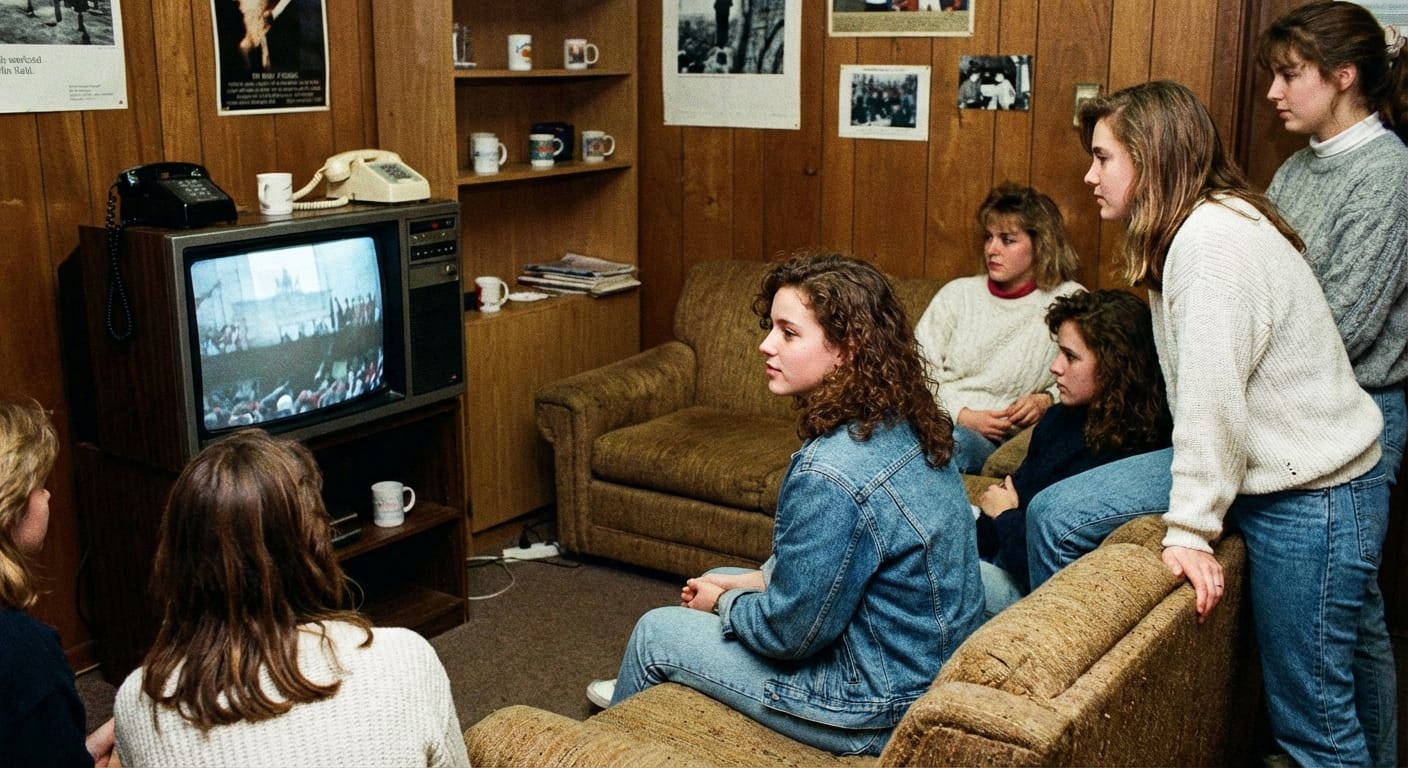
On the screen were strangers, but not the distant kind. Linda Fischer watched them hug in a way that didn’t look rehearsed for cameras—arms tight, faces pressed in, people laughing and crying at once. She noticed the physicality of it: hands on shoulders, the way relief can make a person lean into another person as if gravity has changed. And then, almost unbelievably, the soundless violence of tools against concrete—people chipping pieces off the Wall as if they were breaking open a sealed room.
History that didn’t stay in the textbook
In college, so much of life is lived in the near future—papers, tests, weekends, the next semester. Linda Fischer’s memory holds the moment those small deadlines got interrupted by something enormous. The Berlin Wall had been a fixed idea for as long as she’d been aware of world affairs: a hard line that seemed permanent because adults talked about it like it was permanent. Seeing it treated as something that could be climbed, touched, dismantled—on a dorm TV, of all things—rewired what “possible” meant, right there in the lounge.
It’s easy to forget how shocking that visual would have been in 1989: not a polished documentary looking back, but live footage with all the messy, breathless energy of the present tense. Linda Fischer wasn’t reading about a turning point years later; she was watching it happen with a roomful of other students who were, in their own ways, growing up in the exact same instant the world was changing.
“Like the world had just taken a deep breath”
That line says everything about why this stayed with Linda Fischer. A deep breath is physical—you feel it in your chest, the pause at the top, the release. Her memory isn’t only about geopolitics; it’s about a sensation: the collective loosening of something held too long. The strangers on the screen weren’t only celebrating; they were exhaling. And in the dorm lounge, Linda Fischer felt that exhale travel through the television into her own body.
Maybe that’s why the television news broadcast is the item that anchors this story. TVs are usually background noise, but that night it became a threshold—one side: the ordinary rhythm of college life; the other: the sight of barriers giving way under human hands. Linda Fischer didn’t have to be in Berlin to feel the weight of it. She just had to be there, in that lounge, standing close enough to the screen to see faces, and close enough to others to sense a shared quiet amazement.
Long after November 1989, what remains is not a list of headlines. It’s the image of people hugging at the edge of a world that had been divided, and the startling knowledge—delivered through a dorm TV—that something solid can crack, and when it does, everyone in the room notices themselves breathing differently.
Your Memory on Merch
Love this memory? We can put it on a mug, t-shirt, tote bag, poster, and more! Click below to request your custom merchandise.


About the Storyteller
Linda Fischer
Memory from November 1989