
Kevin Marshall and the Christmas 1985 Moment Mario Finally Appeared
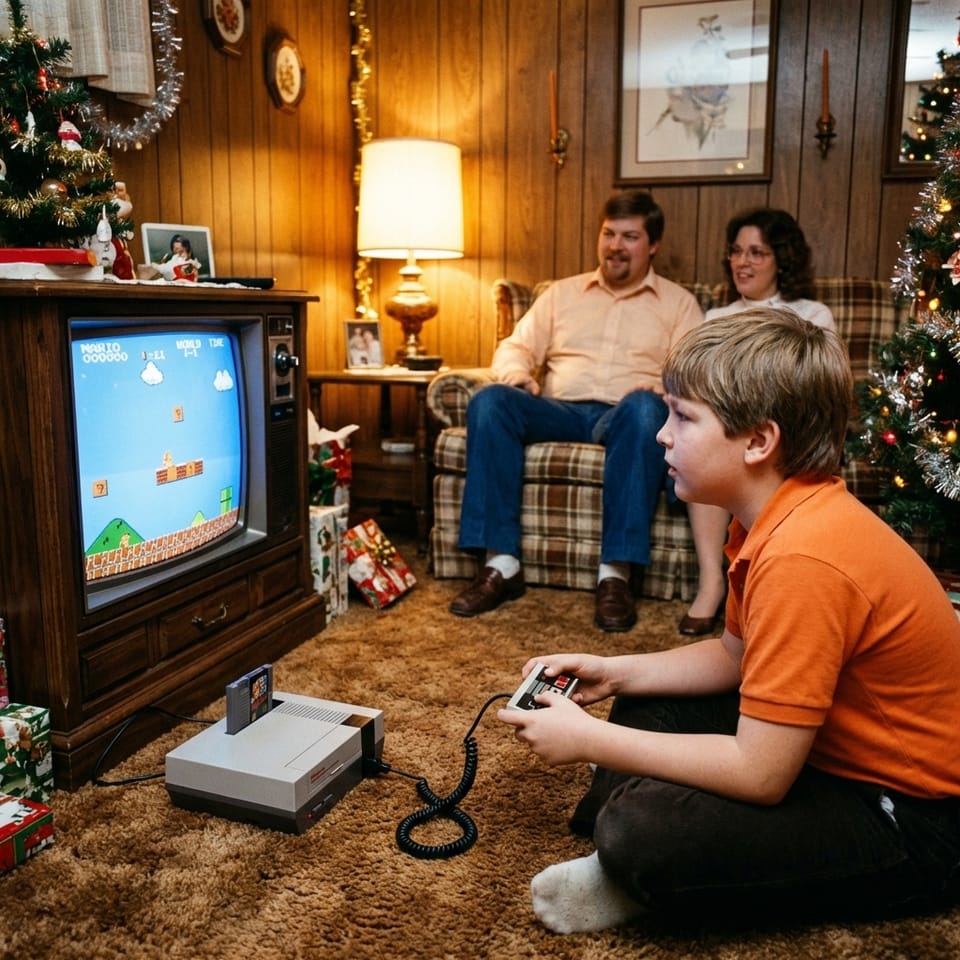
Kevin Marshall still remembers how the box looked before it ever became a part of his life—robot on the front, a console pictured like a piece of the future, and a promise that somehow felt larger than the living room it was about to take over. Christmas 1985 had plenty of gifts, but this one carried a different kind of weight: the sense that whatever was inside wasn’t quite like the other toys.
This memory is brought to you by Oh Sherri Irish Pub — Testing the partner system

This story is brought to you by
Oh Sherri Irish Pub
Testing the partner system
Visit Oh Sherri Irish Pub →The box showed a robot, a console, and a promise that felt bigger than any toy I’d ever seen. My parents weren’t even sure what it was exactly—just that it was “the new thing.” When we hooked it up to the TV, it took a few tries. You had to push the cartridge in just right, press it down, and hope the screen didn’t flash that blinking gray. Then suddenly… it worked. Mario appeared on the screen, and for the first time, I wasn’t just watching something—I was controlling it. Running, jumping, figuring things out as I went. It felt completely different from anything before it. My friends came over the next day, and we took turns passing the controller, arguing over whose turn it was and how far we could get without losing all our lives. We didn’t know it then, but that little gray box wasn’t just a toy. It was the beginning of something that would stick with us for decades.
There’s something almost sacred about the way Kevin Marshall describes the setup—the little ritual of getting the Nintendo Entertainment System to cooperate. Not because it was elegant, but because it demanded belief. The grey console sat there looking calm and ordinary, while the real drama lived in the tiny motions: lining up the Super Mario Bros. cartridge, pushing it in, pressing it down, and waiting to see whether the TV would reward you with color or punish you with that blinking gray nothing.
And Kevin Marshall’s parents, hovering nearby, didn’t have to fully understand it to be part of it. They just had to be present for the moment it shifted from “a gift we bought” into “a thing that works.” The NES didn’t arrive with a family history attached—no hand-me-down stories, no traditions. It was “the new thing,” and that meant all the meaning had to be made right there on the carpet in real time.
The instant the screen changed, so did the room
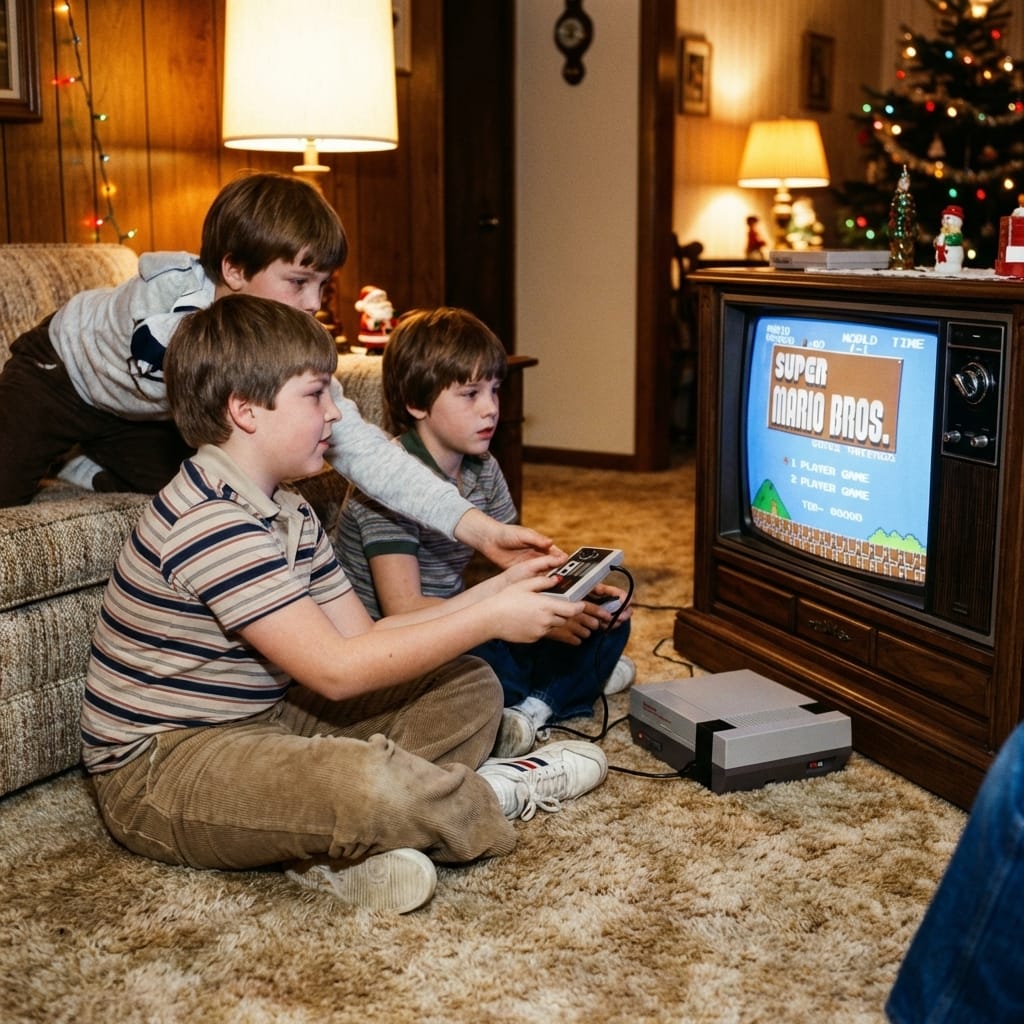
When Mario finally appeared, Kevin Marshall wasn’t just looking at a character—he was holding the reason the room felt different. The rectangular controller made him the engine of what happened next. Run. Jump. Fall. Learn. Try again. It wasn’t passive like Saturday morning cartoons, and it wasn’t pretend like action figures. It was a world that answered back immediately, in the plainest language possible: do this, and this happens.
That’s what makes the memory land so hard decades later. Not because the graphics were “good” by any modern measure, but because the experience was new in the most personal way: Kevin Marshall felt himself crossing a line from watching to steering. Even the mistakes mattered, because they were his mistakes—proof he was inside the thing, not outside it.
By the next day, the NES had already started doing what it would keep doing for years: gathering people. Kevin Marshall’s friends came over, and the living room became a small, loud courtroom where the only law was whose turn it was and whether someone had been “cheating” by taking too long. Passing the controller wasn’t just fairness—it was a way of sharing the wonder without admitting how badly you wanted to keep it in your hands.
A small grey box with a long shadow
Kevin Marshall didn’t need to know anything about the video game industry in 1985 to sense the size of what had arrived. The NES didn’t feel like a toy that would be forgotten when the batteries died. It felt like a device—something closer to the family TV than to a plastic figure—except it belonged to him and his friends in a way the TV never did.
And that may be the deepest ache in the memory: how ordinary the moment looked from the outside. A child. A living room. A cartridge that needed to be pushed “just right.” But from Kevin Marshall’s side of the screen, it was the first time a world opened because he made it open. A simple start-up chime replaced by motion and possibility. A character running because he said run.
Christmas 1985 becomes more than a date when Kevin Marshall tells it. It becomes the start of a long relationship with play that didn’t fade when the wrapping paper was thrown away. The arguing, the turn-taking, the stubborn hope that this time the blinking gray would give way—it all reads now like the beginning of a language he and his friends would speak for decades without realizing they’d learned it that morning.
Photos from the Memory

Your Memory on Merch
Love this memory? We can put it on a mug, t-shirt, tote bag, poster, and more! Click below to request your custom merchandise.


About the Storyteller
Kevin Marshall
Memory from Christmas 1985