
Jay Leno and the 1994 McLaren F1: The Crown Jewel He Refuses to Put on a Pedestal
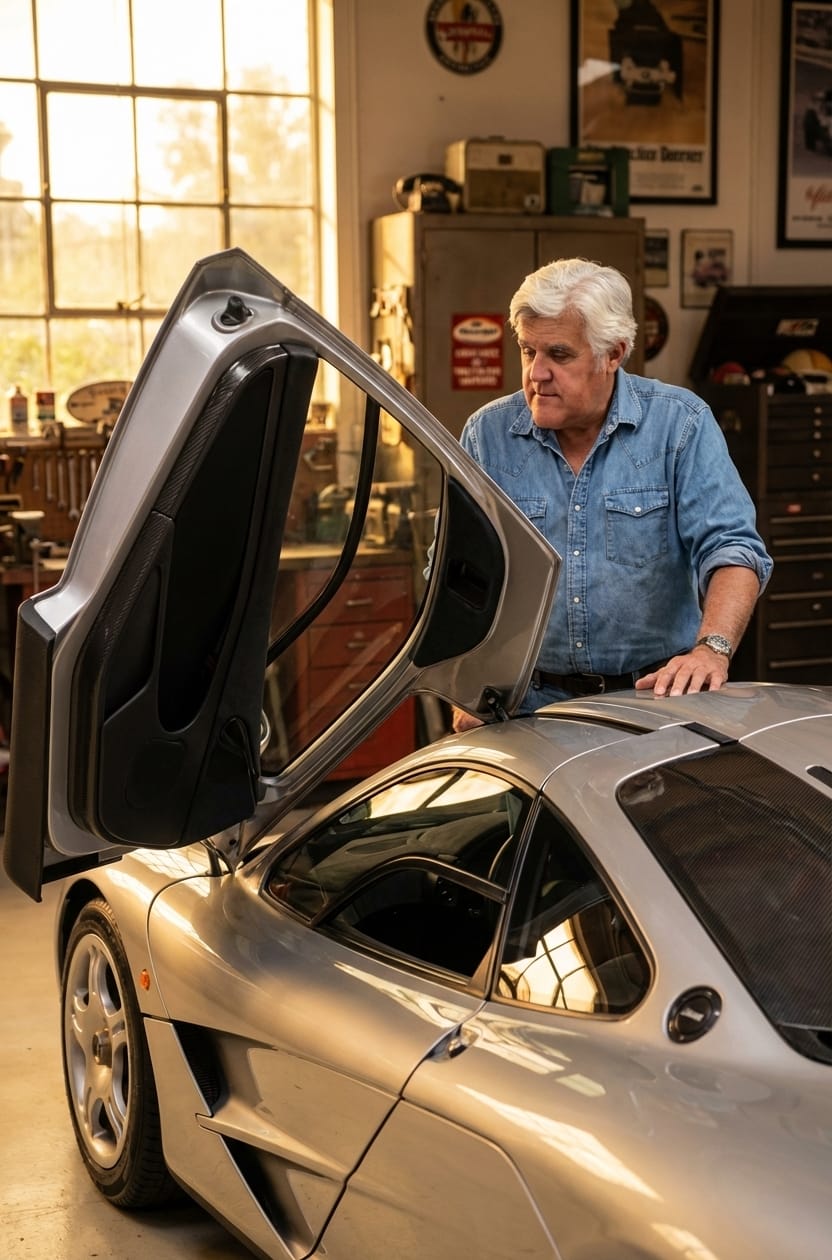
Some cars arrive in your life like trophies—meant to be dusted, photographed, and kept just out of reach. Jay Leno’s 1994 McLaren F1 never agreed to that arrangement. Even with all the noise around values and rarity and bragging rights, this particular machine—chassis #015—has always felt less like a possession and more like a living, breathing argument for why driving matters.
Jay Leno bought the 1994 McLaren F1 in the mid-to-late 1990s for around $800,000, which sounds like an absurd sentence until you remember what the car was back then: not a myth yet, not a punchline for auction headlines—just a brutally serious idea from Gordon Murray about what the “ultimate road car” could be if you built the mechanical truth first and let everything else follow. The kind of purchase that isn’t about being first; it’s about recognizing something before the world finishes naming it.
"Jay Leno owns both the 1994 McLaren F1 and its spiritual successor, the McLaren P1, which serve as the "crown jewels" of his extensive automotive collection. While the F1 is a naturally aspirated, three-seater "analog" masterpiece, the P1 represents the brand's shift into hybrid hypercar technology with twin-turbocharged power and electric assistance. 1994 McLaren F1 Leno purchased his 1994 McLaren F1 (chassis #015) in the mid-to-late 1990s for approximately $800,000. Despite its massive appreciation, he drives it regularly rather than keeping it as a "garage queen". Valuation: As of early 2026, the car is estimated to be worth between $17 million and $20 million. Engine: It features a BMW-sourced 6.1-liter V12 engine producing 627 horsepower. Design: Notable for its central driving position and three-seat layout, it was designed by Gordon Murray to be the "ultimate road car". Performance: It held the world record for the fastest production car for years, reaching a top speed of 240.1 mph. Unique Features: The engine bay is lined with 24-carat gold to act as a heat reflector for the high-temperature V12. McLaren P1 Leno was the first customer outside of McLaren to drive a P1 and took delivery of one of the first production units (P1 #002) in early 2014. He famously added over 1,000 miles to the odometer within just one week of ownership. Powertrain: A hybrid system combining a 3.8-liter twin-turbo V8 with an electric motor, generating a total of 903 to 916 horsepower. Technology: It uses "torque fill" to eliminate turbo lag, where the electric motor provides instant power while the turbochargers spool up. Performance: It can accelerate from 0 to 62 mph in 2.8 seconds and has an electronically limited top speed of 217.5 mph. Rarity: Only 375 units were ever produced globally. Daily Usability: Leno has praised the P1 for its versatility, noting it is "comfortable around town" but can become a track-focused beast at the touch of a button. Leno considers these cars to be icons that set the stage for modern performance, frequently comparing them to the newest addition to his collection, the McLaren."
When “Crown Jewel” Still Smells Like Fuel
Calling the 1994 McLaren F1 a “crown jewel” would be easy to misread—like it sits under lights, guarded by velvet rope. But Jay Leno’s version of precious has always been practical in the best way: precious means used. This is the part that quietly tells you who Jay Leno is. Because if you truly believe a car is one of the best ever built, you don’t entomb it. You learn it. You keep your hands honest. You let it start, warm, and speak.
Love classic memories?
Share your brand with our nostalgic community. Become an Advertising Partner and connect with readers who cherish the classics.
And the F1 speaks in a language that’s getting rarer every year. A BMW-sourced 6.1-liter V12 making 627 horsepower without turbochargers, without electric assist—just air, fuel, and engineering confidence. It’s an “analog masterpiece,” which isn’t nostalgia as a marketing term; it’s a physical feeling. There’s a directness to it that turns your senses up, like someone cleaned the windshield not only in front of you, but inside your head.
Then there’s the central driving position—the detail people repeat because it sounds exotic, but for Jay Leno it’s also a private kind of clarity. Sitting in the middle means you’re not cheating the experience by leaning toward a curb or hiding behind the offset of a normal cockpit. You’re centered in the intent of the machine. The road comes at you straight. It’s hard to be casual in a car that demands you sit like the point of a spear.
Gold Foil and Consequences
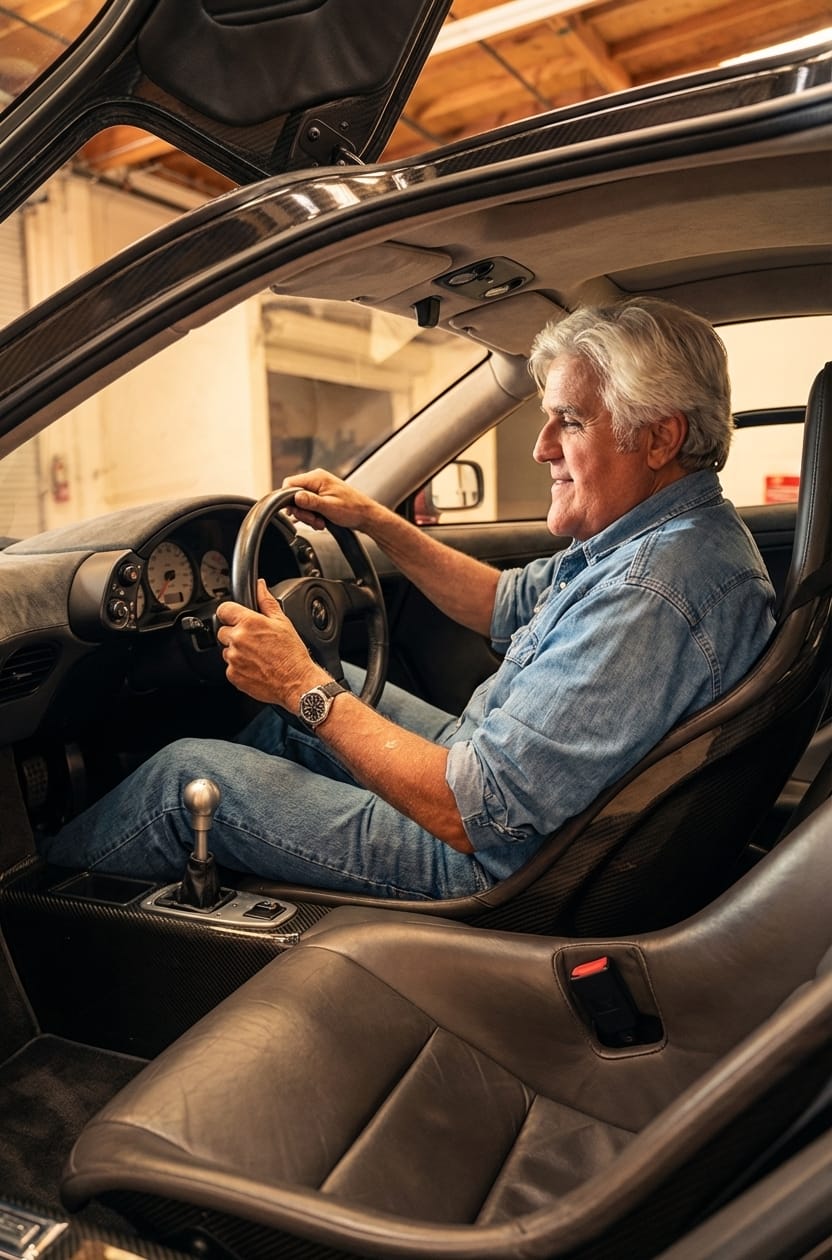
The 24-carat gold lining in the engine bay isn’t jewelry; it’s a heat reflector—McLaren solving a real problem with a material people associate with status. That detail feels like a perfect metaphor for why Jay Leno keeps coming back to this car. The F1 isn’t trying to impress you with luxury; it’s trying to protect itself from its own seriousness. The gold is there because the V12 runs hot enough to require it, and that kind of honesty can make you laugh out loud when you see it.
Somewhere in the background of all this is the uncomfortable modern truth: as of early 2026, Jay Leno’s 1994 McLaren F1 is estimated between $17 million and $20 million. That number has weight. It changes how people talk to you about the car. It invites a kind of fear that has nothing to do with driving. But Jay Leno keeps choosing the original promise of the thing—driving it rather than turning it into a fragile headline.
The F1’s Shadow, the P1’s Light
The McLaren P1 shows what happens when the world moves forward and refuses to apologize for it. Jay Leno wasn’t just an early adopter—he was the first customer outside McLaren to drive one, and he took delivery of P1 #002 in early 2014. Then, in the most Jay Leno detail possible, he put more than 1,000 miles on it in a week. Not to prove anything. Just because he could, and because it felt wrong not to.
The P1’s hybrid system—twin-turbo V8 plus electric motor, total output in the 903–916 horsepower range—marks a very different era. It has “torque fill,” where the electric motor smooths the gap while turbos spool. It’s a technical solution to a modern expectation: instant response, no waiting, no awkward breath between intention and acceleration. And yet Jay Leno talks about it the way a driver would: comfortable around town, then ferocious when you touch the right button. A car that can behave until you ask it not to.
Only 375 P1s exist, which should make it feel like a museum piece. But in Jay Leno’s hands it becomes something else: evidence that “rare” doesn’t have to mean “untouched.”
What Jay Leno Keeps Protecting
It would be easy to frame this as a story about two hypercars—one analog, one hybrid—two eras parked side by side. But the real story is the way Jay Leno uses them as measuring sticks for sincerity. The F1, with its three-seat layout and central command position, is an answer to a question most manufacturers stopped asking: what if the driver mattered more than the interface? The P1 is a different answer: what if technology could amplify a driver without muting them?
And maybe that’s why these cars sit at the top of Jay Leno’s internal list—not because they’re the fastest, or the most expensive, or the hardest to obtain, but because they still feel like someone built them with conviction. The kind of conviction you can hear in a naturally aspirated V12 at full song, and also feel in a hybrid system that’s smart enough to hide its own complexity until you need it.
For Jay Leno, the “crown jewels” aren’t there to be looked at. They’re there to remind him what’s real: mechanical choices you can feel through your hands, engineering solutions that don’t need excuses, and the simple sanity of taking something extraordinary out into the world and letting it do what it was born to do.
Photos from the Memory

Your Memory on Merch
Love this memory? We can put it on a mug, t-shirt, tote bag, poster, and more! Click below to request your custom merchandise.
About the Storyteller
Jay Leno
Memory from 1994
Connect with Jay using the info below: