
Henry Morton Stanley and the weight of one polite sentence: “Dr. Livingstone, I presume?”
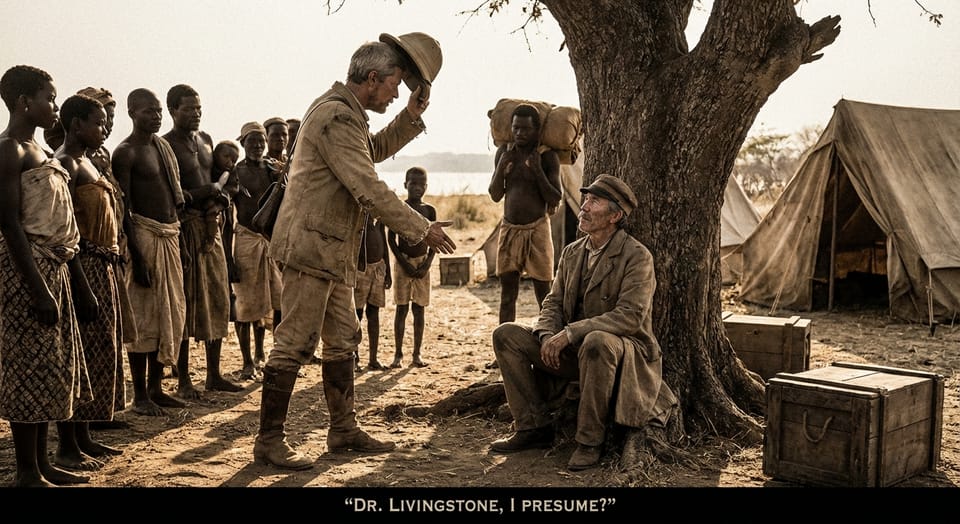
Henry Morton Stanley carried a sentence across continents like it was something he could keep in his pocket—small enough to sound calm, heavy enough to change the way the world would remember him. In his telling, the words arrived not as a shout, not as a collapse into relief, but as a measured greeting offered on the edge of exhaustion, where composure becomes its own kind of confession.
This memory is brought to you by Red Bike Coffee Company — Second test partner
This story is brought to you by Red Bike Coffee Company
""Dr. Livingstone, I presume?" Was The Greeting March, 19th 1813 When Henry Morton Stanley Found Dr. Livingstone! "Dr. Livingstone, I presume?" is a famous greeting used to acknowledge someone's identity when it seems obvious but remains technically unconfirmed. It is often used humorously or to recognize someone with a notable or unmistakable presence. Historical Context The phrase originated from a real-life historical event on November 10, 1871. The Search: Dr. David Livingstone, a famous Scottish missionary and explorer, had been "lost" in Africa for several years while searching for the source of the Nile River. The Meeting: Journalist Henry Morton Stanley was sent by the New York Herald to find him. After a grueling trek, he located Livingstone in Ujiji, Tanzania. The Remark: Despite the extreme circumstances, Stanley reportedly approached the only white man in the village and uttered the formal, understated greeting: "Dr. Livingstone, I presume?". Why It Became Famous Victorian Formality: The quote became iconic because it illustrated the rigid, overly proper social manners of the Victorian era. Instead of an emotional outburst after a dangerous multi-year search, Stanley chose a remarkably calm and polite inquiry. Journalistic Promotion: Stanley was a self-promoting reporter, and his account of the meeting—published in major newspapers—captured the public's imagination and solidified the line in cultural history. Modern Usage Today, the phrase is frequently parodied in movies, TV shows, and songs (like the 1968 track by The Moody Blues). It serves as a shorthand for: Finding someone who has been difficult to locate. Meeting someone famous or highly anticipated. Recognizing a person whose identity is clear from the context, even if you've never met before."
The day and the date you keep returning to
Henry Morton Stanley wrote down March 19th, 1813 as if memory itself can have a stubborn streak—like a story you’ve repeated so many times that the date becomes part of the rhythm, even when history argues back. The world’s record points to November 10, 1871, in Ujiji on Lake Tanganyika, but your submission holds both: the human version and the textbook version, side by side. And somehow that split feels fitting, because your sentence—your sentence—is exactly about that thin line between what’s obvious and what’s technically confirmed.
Because that’s what the greeting does. It pretends to be paperwork. It sounds like an introduction at a drawing room door. But in your mouth—after the search, after the miles, after all the waiting baked into the phrase “lost for years”—it becomes something else: a way to keep your hands from shaking in public.

Ujiji, the only white man, and the choice you made in front of everyone
In the version you carry, you don’t stumble into the moment accidentally. You arrive as a journalist sent with a mission—find Dr. David Livingstone—and you meet him with the kind of restraint that makes people talk. You could have said anything. You could have said everything. Instead you chose the smallest possible bridge between strangers: a formal question shaped like certainty.
It’s easy for people, later, to laugh at the Victorian tidiness of it. You already know that; you named it. But what sticks is the particular kind of courage in refusing melodrama. When you wrote “the only white man in the village,” you weren’t just giving a detail for a history book—you were describing how unmistakable the moment was. The answer was standing right there. And still you offered him dignity, the courtesy of being asked.
How a reporter becomes a character in his own headline
Henry Morton Stanley understood—maybe too well—how a story survives. You didn’t just witness the encounter; you had to translate it into a line people could carry home. And that line outlived the sweat, the fear, and the miles. It became a cultural shorthand, something people toss around when they finally locate a friend in a crowd, or meet a legend they’ve only heard about.
That afterlife is both flattering and bruising, isn’t it? The world takes your careful composure and turns it into a punchline. Songs echo it. Films parody it. The greeting becomes larger than the man who said it—or was said to have said it. Even the doubt that historians raise about the exact wording only adds to the odd intimacy of your memory: whether or not every syllable is provable, the scene still belongs to you, because you are the one who had to decide what kind of man to be in that instant.
The private meaning inside a public sentence
There’s a loneliness hidden inside “I presume?”—a little hedge, a thin veil—like you were protecting both of you from the rawness of what it meant to finally arrive. You framed reunion as etiquette. You made discovery sound like manners. And maybe that was the only way to keep it from breaking you open.
When people repeat the phrase today, they repeat the calm. They rarely repeat what it cost. But your memory does. It keeps the grueling search attached to the politeness, and it refuses to let the line float away as mere cleverness. In your telling, the greeting isn’t a joke; it’s the shape you gave to overwhelming relief.
Your Memory on Merch
Love this memory? We can put it on a mug, t-shirt, tote bag, poster, and more! Click below to request your custom merchandise.


About the Storyteller
Henry Morton Stanley
Memory from 1813
Connect with Henry using the info below:
https://www.facebook.com/amplifyaiworkshop