Harvey and the May 9, 1914 Newspaper That Made Mother’s Day Official
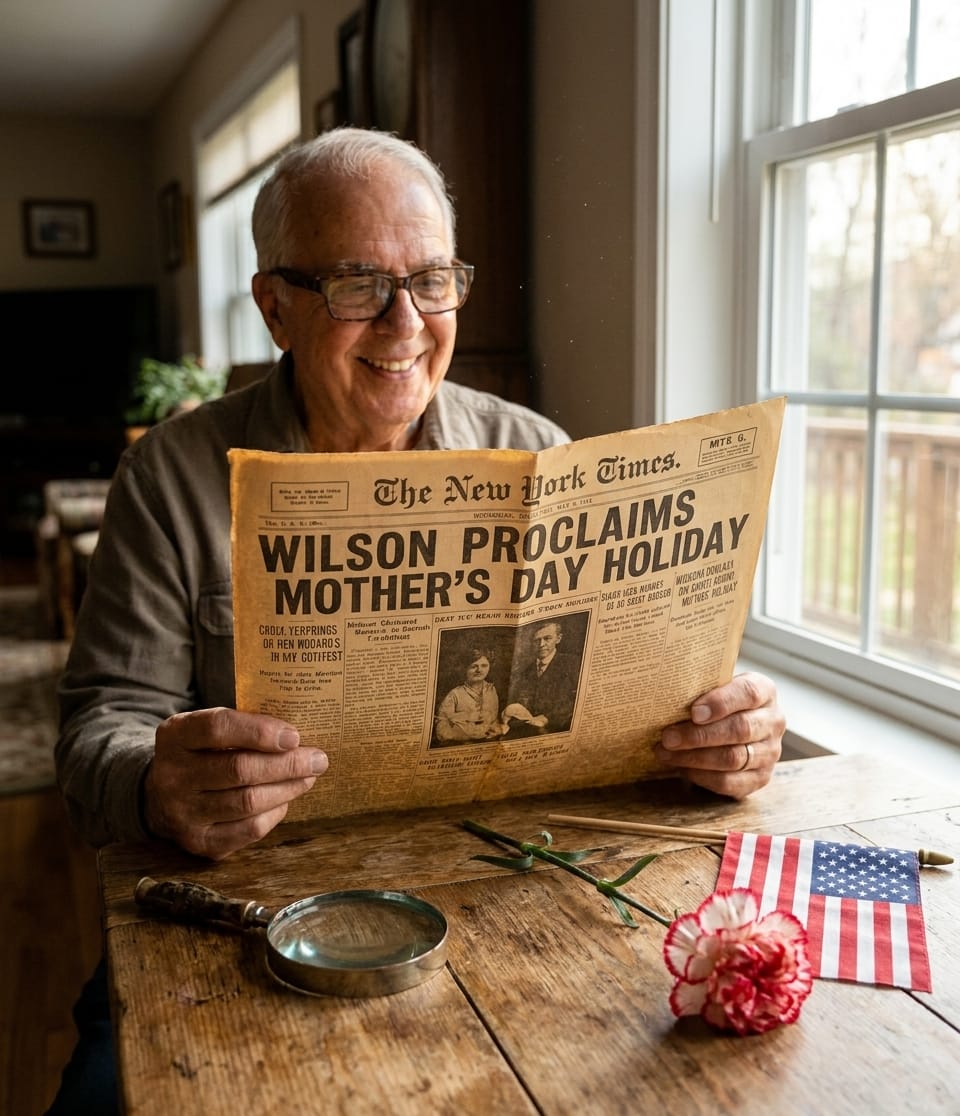
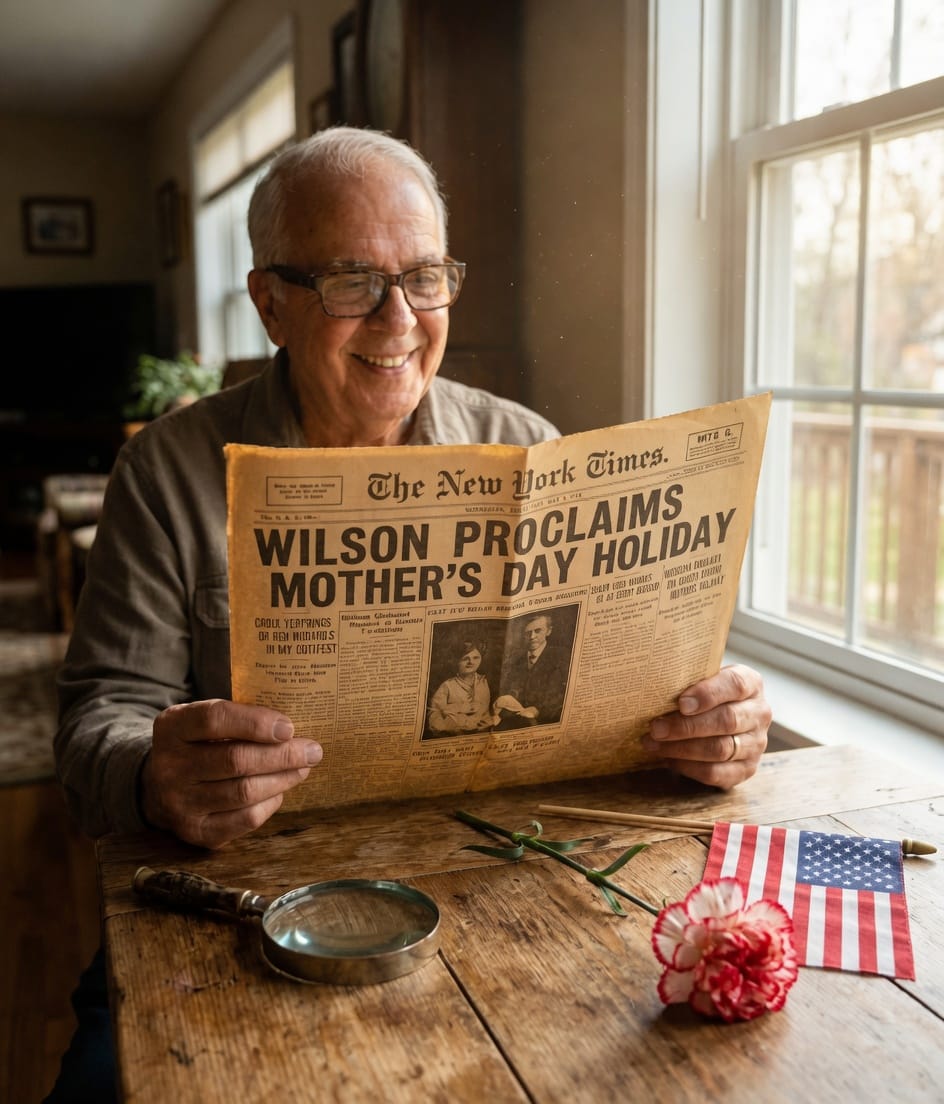
Harvey didn’t just “learn” a fact about history—Harvey held it, thin and crackling, in the form of an old May 9th, 1914 newspaper where the headline carried a kind of quiet authority: President Woodrow Wilson, in ink that had outlived everyone who first read it, had officially established Mother’s Day as a national observance. There’s something about a newspaper that old—how it refuses to feel like a screen—that makes a moment like that land in the chest instead of the brain.
This memory is brought to you by Red Bike Coffee Company — Second test partner
This story is brought to you by Red Bike Coffee Company
"Harvey Finds An Old May 9th 1914 Newspaper with Headlines Saying: “On May 9, 1914, President Woodrow Wilson issued Proclamation 1268, which officially established Mother's Day as a national holiday on the second Sunday of May."President Woodrow Wilson, on Saturday, May 9, 1914, made the official announcement proclaiming Mother's Day a national observance to be held each year on the 2nd Sunday of May, thereby making May 10, 1914 the first national Mother’s Day.
The observance was to take the form of displaying the American Flag on government buildings and private homes "as a public expression of our love and reverence for the mothers of our country."
Mother's Day was almost universally observed before 1914, as most states had observances, but the date sometimes varied. Traditionally, vendors sold carnations for churchgoers to wear, red for those whose mother was living and white for those whose mother had died.
The most widely promoted history of Mother's Day in the U.S. attributes it's establishment to Ana Jarvis, from Philadelphia, who in 1907 began a campaign to establish a national Mother's Day. Jarvis persuaded her mother's church in Grafton, West Virginia to celebrate Mother's Day on the second anniversary of her mother's death, the 2nd Sunday of May.
The next year Mother's Day was also celebrated in Philadelphia. Jarvis and others began a letter-writing campaign to ministers, businessmen, and politicians in their quest to establish a national Mother's Day. This poster advertises the annual Mother's Day in Pennsylvania.
However, according to the Katharine Antolini, author of Memorializing Motherhood: Anna Jarvis and the Struggle for Control of Mother's Day, there were at least two other early proponents of Mother's Day.
Julia Ward Howe proposed a "Mothers' Peace Day" as a way to "promote global unity after the horrors of the American Civil War and Europe’s Franco-Prussian War."
These early observances were primarily popular with peace activists.
And Frank Hering, of the University of Notre Dame, proposed the idea of a national Mother's Day as early as 1904.
Hering urged an Indianapolis gathering of the Fraternal Order of Eagles to support “setting aside of one day in the year as a nationwide memorial to the memory of Mothers and motherhood."
Several local branches of the FOE followed.
Many people consider Hering the 'Father' of Mother's Day, much to Ana Jarvis' chagrin.
#MothersDay #WoodrowWilson #AnnaJarvis #Americanflag #CongressionalAction"
What stays with me about Harvey’s find is how it turns a holiday we casually “remember” into something you can almost overhear being invented in real time. That paper is dated Saturday, May 9, 1914—the day Wilson’s proclamation went out—so Harvey isn’t looking at a tidy recap from years later. Harvey is looking at the present tense of a country being told, in effect, “Put the flag out. Make it visible. Let reverence be public.”
And because Harvey’s eyes are the ones meeting those lines, the proclamation stops being just civic language. It becomes intimate. The phrase about displaying the American flag—on government buildings and on private homes—reads differently when you imagine how many porches and windowsills were about to get that instruction. Harvey, holding that issue, can almost feel the sudden unity of it: separate families, separate kitchens, the same gesture.
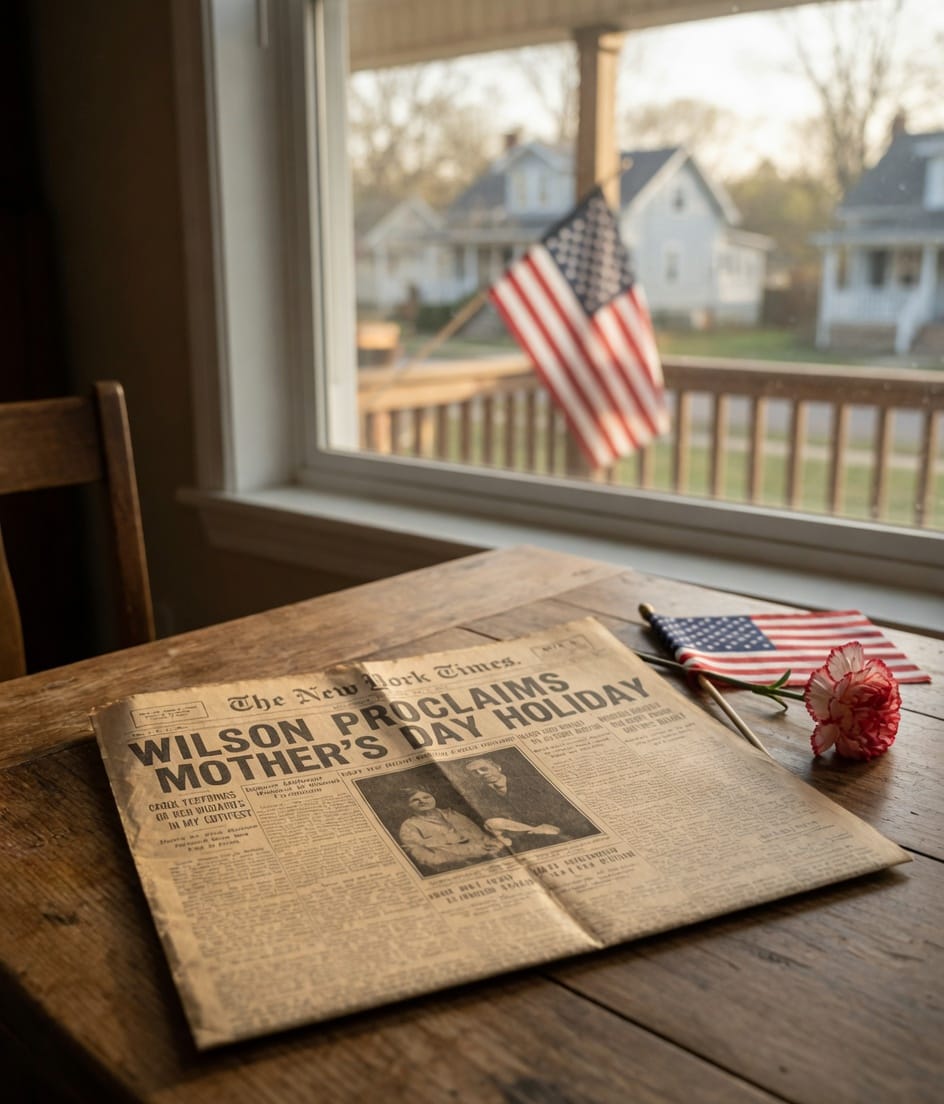
Then there are the carnations—small, specific, almost unbearably human details tucked into the history Harvey is tracing. Red if your mother is living, white if she’s gone. That old tradition has a way of making the past feel close enough to touch, because it’s not about Congress or proclamations. It’s about what someone pins to a lapel before church, and what they can’t say out loud yet, so they let a flower do it.
Harvey’s newspaper also carries the quieter argument underneath the celebration: Mother’s Day didn’t arrive as one neat idea that everyone agreed on. The paper remembers Anna Jarvis and her fierce, letter-writing insistence; it nods to Julia Ward Howe’s hope that mothers could be a moral force against war; it includes Frank Hering’s campaign language about “a nationwide memorial.” In Harvey’s hands, those names aren’t trivia—they’re proof that love, when it’s big enough, tends to attract competing versions of itself.
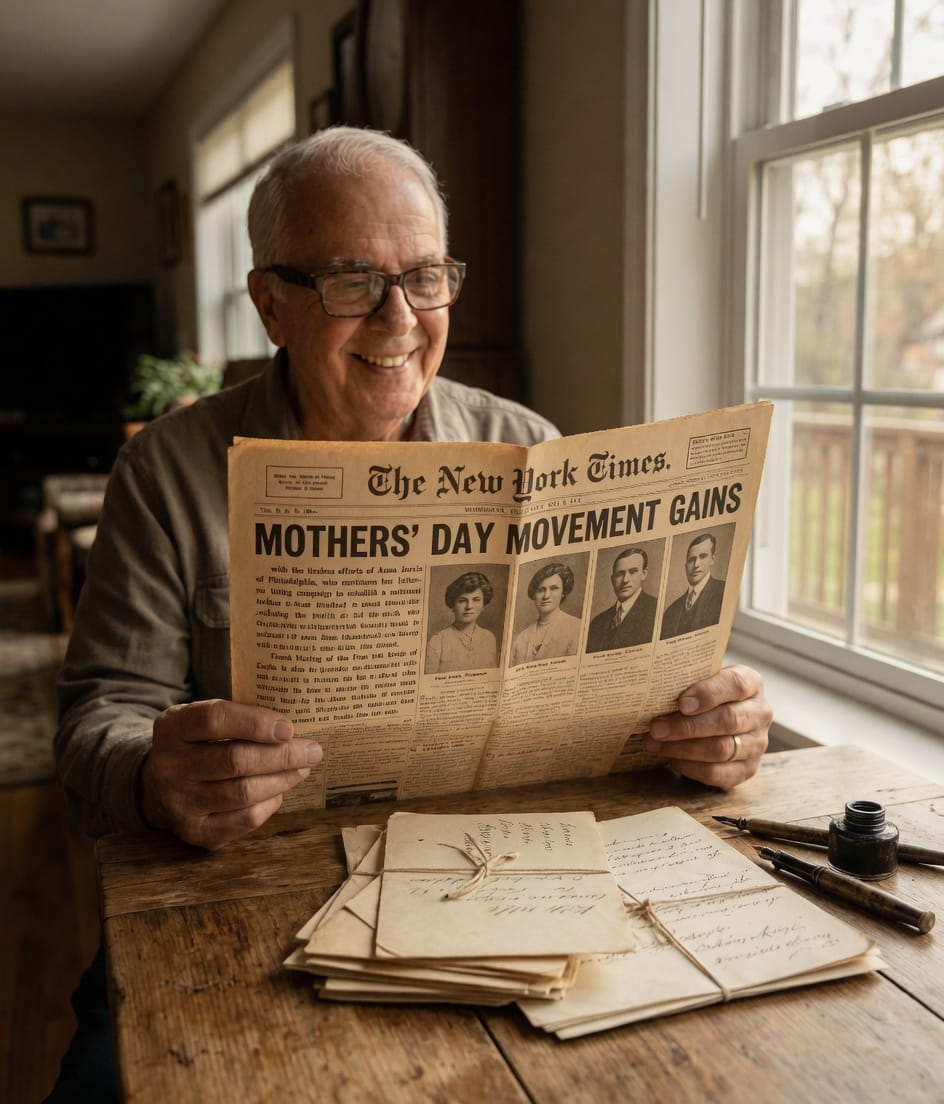
There’s a particular feeling that comes from reading history through yesterday’s paper instead of today’s voice: the humility of realizing the people in 1914 had no idea what Mother’s Day would become. Harvey’s discovery preserves that uncertainty. It keeps the holiday close to its original size—less commercial, more like a pledge made out loud: that mothers mattered enough to be recognized with the flag itself.
Maybe that’s the real gift of what Harvey found. Not just the date, not just Wilson’s proclamation, but the sensation of standing next to the moment before it hardened into tradition. For Harvey, the headline is a doorway. You can step through it and remember that even national holidays begin the way most important things do—somebody deciding to honor what raised them, and insisting the rest of the world look up and notice.
Photos from the Memory

About the Storyteller
Harvey
Memory from 1914
Connect with Harvey using the info below:
https://www.facebook.com/silver.fox.9862/