Happy Birthday, Marty Bostick — The 1949 Mercury Coupe Dream Car You’ve Always Deserved (From Your Friend Harvey)

Some birthday wishes are loud—candles, cake, a room full of voices. And some are quieter, built out of knowing someone long enough to understand what really lives in the back of their mind. For Marty Bostick, that wish has a shape: long, low, steel-smooth. A 1949 Mercury Coupe—the kind of car you don’t just admire, you carry.
This memory is brought to you by Oh Sherri Irish Pub — Testing the partner system

This story is brought to you by
Oh Sherri Irish Pub
Testing the partner system
Visit Oh Sherri Irish Pub →"Happy Birthday, Marty Bostick — The 1949 Mercury Coupe Dream Car You’ve Always Deserved From Your Friend Harvey The 1949 Mercury Coupe is a landmark in American automotive history, representing the first major post-World War II redesign for the Mercury brand. Debuting on April 29, 1948, it marked a significant departure from pre-war styling, transitioning to a sleeker "pontoon" body style that eliminated separate fenders and running boards. Facebook Design and Engineering Unified Platform: For the first time, Mercury shared its body and chassis with the Lincoln EL-Series (the "Baby Lincoln") rather than Ford, giving it a wider and lower-slung profile that sat between the Ford and Lincoln brands. Flathead V8 Engine: It was powered by a 255.4 cubic-inch flathead V8 engine producing 110 horsepower—more power than its Ford counterparts. Chassis Innovations: The new design featured a 118-inch wheelbase and introduced an independent front suspension system for improved handling. Cultural Significance and the "Lead Sled" The 1949 Mercury became the definitive foundation for American custom car culture, specifically the "lead sled" movement. Customization Potential: Its smooth, rounded body and sturdy steel construction made it the ideal canvas for modifications like chopping rooflines, lowering the suspension, and "frenching" headlights. Barris Brothers: Customizers Sam and George Barris created the most famous versions, including the "Hirohata Merc" (based on a similar 1951 model), which set the standard for the custom look. Hollywood Icon: Its status as a symbol of rebellion was cemented by James Dean, who drove a mildly customized 1949 Mercury in the 1955 film Rebel Without a Cause. Production and Legacy Market Success: The redesign was a massive hit, helping Mercury nearly triple its sales in 1949 compared to previous years. Evolution: While technically part of the "Mercury Eight" series (1939–1951), the 1949–1951 generation is the most sought-after by collectors today. Modern Value: Original or well-customized survivors typically sell for between $25,000 and $50,000, with high-end custom builds reaching over $100,000 at auctions according to Hagerty Valuation Tools.""
What lands hardest in that birthday message isn’t the spec sheet—though it’s all there, and it matters. What lands is the certainty in the phrasing: “the dream car you’ve always deserved.” Harvey isn’t guessing. He’s talking to the part of Marty Bostick that knows exactly what a ’49 Mercury looks like in profile, the part that hears “flathead V8” and doesn’t need anyone to explain why that’s music.
There’s something fitting—almost tender—about the way the 1949 Mercury Coupe arrived in the world: right on the edge of a new era, when everything was trying to look forward without forgetting what it had just lived through. When Harvey ties this car to Marty Bostick’s birthday, it turns a piece of automotive history into a personal timeline. Not “a landmark redesign,” but a symbol that says: you’ve made it through things, too, and you should get to want something beautiful.
It’s easy to imagine Marty Bostick lingering on the details that make this particular year feel like the right one. The “pontoon” body that finally smoothed away the old separate fenders and running boards—like the car exhaled and decided it could be sleek now. The wider, lower stance from sharing bones with the Lincoln EL-Series instead of Ford—subtly saying it didn’t have to be the cheap version of anything. That’s the kind of hidden upgrade a true admirer loves: not flashy bragging, just better proportions when you step back and really look.
And then there’s the engine. A 255.4 cubic-inch flathead V8 making 110 horsepower doesn’t sound like a modern flex, but that’s not what this is about. It’s about the feeling of power that’s honest—mechanical, direct, unpretending. The kind of power you can picture Harvey handing to Marty Bostick in the form of a birthday wish: not “here’s something shiny,” but “here’s something with a heartbeat.”
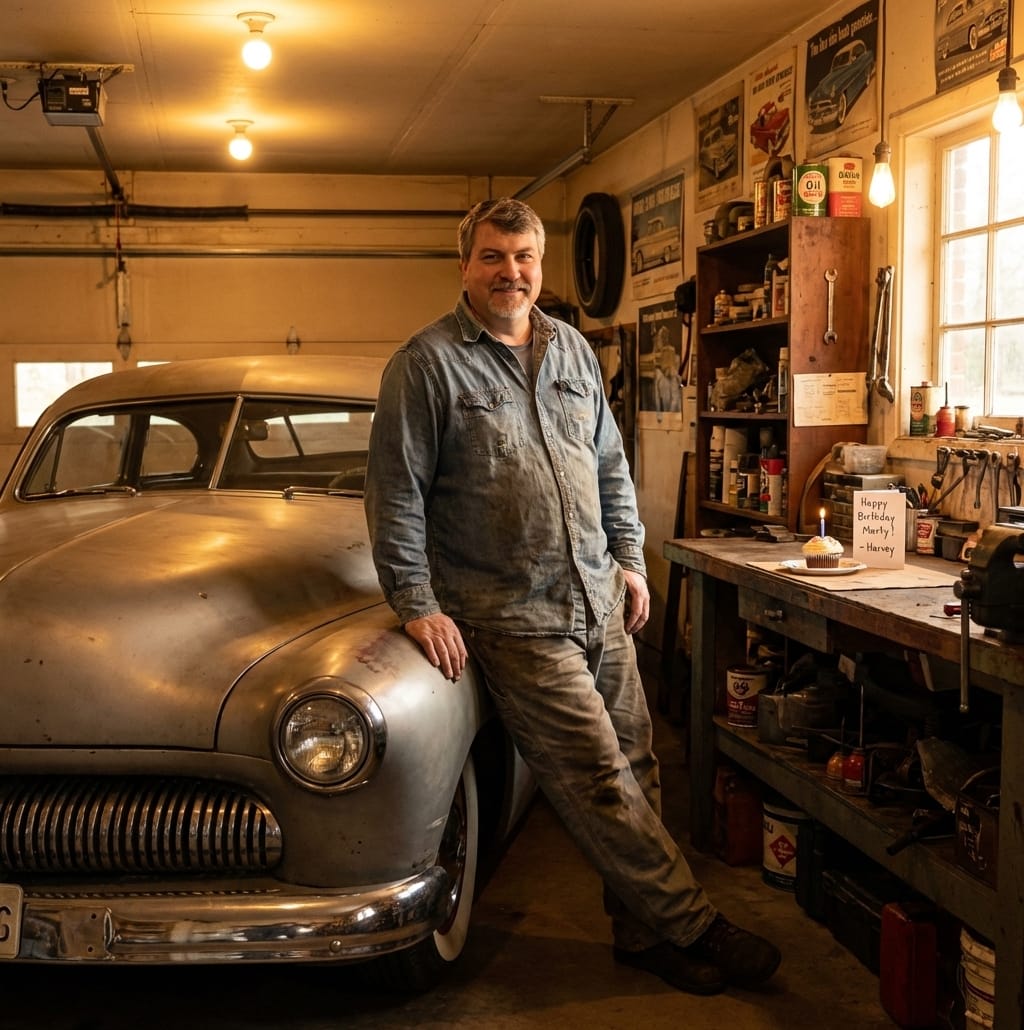
The 1949 Mercury Coupe also carries a second life—one that’s less museum and more midnight. It’s the lead sled foundation, the car that custom culture leaned on because the steel was strong and the lines were willing. When the memory mentions chopping the roof, lowering the stance, frenching the headlights, it reads like an invitation: Marty Bostick doesn’t have to love it at a distance. He can imagine it becoming his—his taste, his restraint, his rulebook.
Even the famous references feel personal when they’re delivered this way. The Barris Brothers’ influence. The shadow of James Dean in Rebel Without a Cause. Those aren’t name-drops here; they’re proof that this car has always belonged to the kind of person who doesn’t want the most common thing on the road. The ’49 Merc is a quiet flag for people who recognize themselves in a silhouette.
And maybe that’s the most intimate part of Harvey’s birthday note to Marty Bostick: it isn’t only about owning a valuable car or chasing an auction number. The mention of modern values—$25,000 to $50,000 for survivors, six figures for the truly high-end builds—doesn’t read like finance. It reads like reassurance. Like Harvey is saying, “You’re not crazy for wanting this. The world agrees this is worth something.”
But birthdays are never really about what things cost. They’re about what people notice. This memory is proof that Harvey notices what Marty Bostick has been carrying—year after year—the long, low dream of a 1949 Mercury Coupe. The kind of dream that’s part style, part history, and part longing.
So if this is a birthday wish, it’s the best kind: specific. Not generic joy, not a throwaway “hope it’s a good one.” It’s a wish with weight and chrome and a stance that sits wider and lower than the cars around it—exactly the way Marty Bostick’s dream has always sat in his imagination.
About Marty Bostick
Name: Marty Bostick
Contact: https://www.facebook.com/silver.fox.9862/
Item: Happy Birthday, Marty Bostick — The 1949 Mercury Coupe Dream Car You’ve Always Deserved From Your Friend Harvey
Year: 1949
Photos from the Memory

Your Memory on Merch
Love this memory? We can put it on a mug, t-shirt, tote bag, poster, and more! Click below to request your custom merchandise.


About the Storyteller
Marty Bostick
Memory from 1949
Connect with Marty using the info below:
https://www.facebook.com/silver.fox.9862/